
The UK has some of the strictest rules in the world for crypto advertising. If you’ve seen a crypto ad on TV, YouTube, or social media recently and wondered why it felt so different - the warning labels, the slow pace, the lack of flashy promises - that’s because the Financial Conduct Authority (FCA) changed everything in 2023. And it’s only gotten tighter since.
What Exactly Changed in 2023?
Before October 8, 2023, crypto companies could advertise almost freely in the UK. You saw ads for Bitcoin, Ethereum, and trading platforms with promises of quick returns, celebrity endorsements, and minimal warnings. That ended with the Financial Services and Markets Act 2000 (Financial Promotion) (Amendment Order) 2023. This law didn’t just tweak rules - it redefined crypto as a Restricted Mass Market Investment. That means any ad promoting crypto assets like Bitcoin, Ethereum, or even fan tokens now falls under the same strict rules as high-risk financial products like CFDs or options.
The FCA didn’t just slap on a disclaimer. It built a full system around it. Every ad must now include a personalized risk warning. Not a generic one-size-fits-all line like “Cryptocurrencies are volatile.” It has to be tailored to the person seeing it - based on their experience, knowledge, and past investment behavior. That’s why you’ll now see pop-up questions before an ad even plays: “Have you traded leveraged products before?” “Do you understand market volatility?”
The 24-Hour Cooling-Off Rule
One of the most practical changes is the mandatory 24-hour cooling-off period. If you click on a crypto ad, fill out a form, and start the sign-up process, the firm can’t let you deposit money or confirm your investment until at least 24 hours have passed. This isn’t optional. It’s built into the system. Firms must use technical controls to block transactions during this window. The goal? To stop people from acting on impulse after seeing a slick ad.
Think about it: most people don’t spend 24 hours researching a new phone. But now, they’re expected to do that before putting money into Bitcoin. The FCA knows crypto is risky - and they’re not letting ads bypass that reality.
Broadcast Ads Are Now Banned on Mainstream TV and Radio
In October 2024, the Broadcast Committee of Advertising Practice (BCAP) - the body that oversees TV and radio ads in the UK - added Rule 14.5.5. This rule bans any ad for fungible or transferable cryptoassets from appearing on mainstream channels. No more crypto ads during prime-time TV shows, football matches, or morning radio.
They’re only allowed on specialized financial programming - like Bloomberg TV, Financial Times Live, or channels that require viewers to prove they’re professional investors. Even then, the ad must include a pre-vetting confirmation that the viewer has passed the FCA’s appropriateness test. That means if you’re not a trader with years of experience, you won’t see those ads at all.
This is stricter than the EU’s MiCA rules, which still allow ads with disclaimers on general channels. The UK’s approach is clear: if you’re not already experienced, you shouldn’t be seeing this.

What Firms Must Do to Stay Legal
Any crypto firm advertising in the UK must now have:
- A system to deliver personalized risk warnings
- Technical controls to enforce the 24-hour cooling-off period
- Client categorization tools to separate retail from professional investors
- Appropriateness assessments that ask detailed questions about crypto knowledge
- Record-keeping of every ad and interaction for at least five years
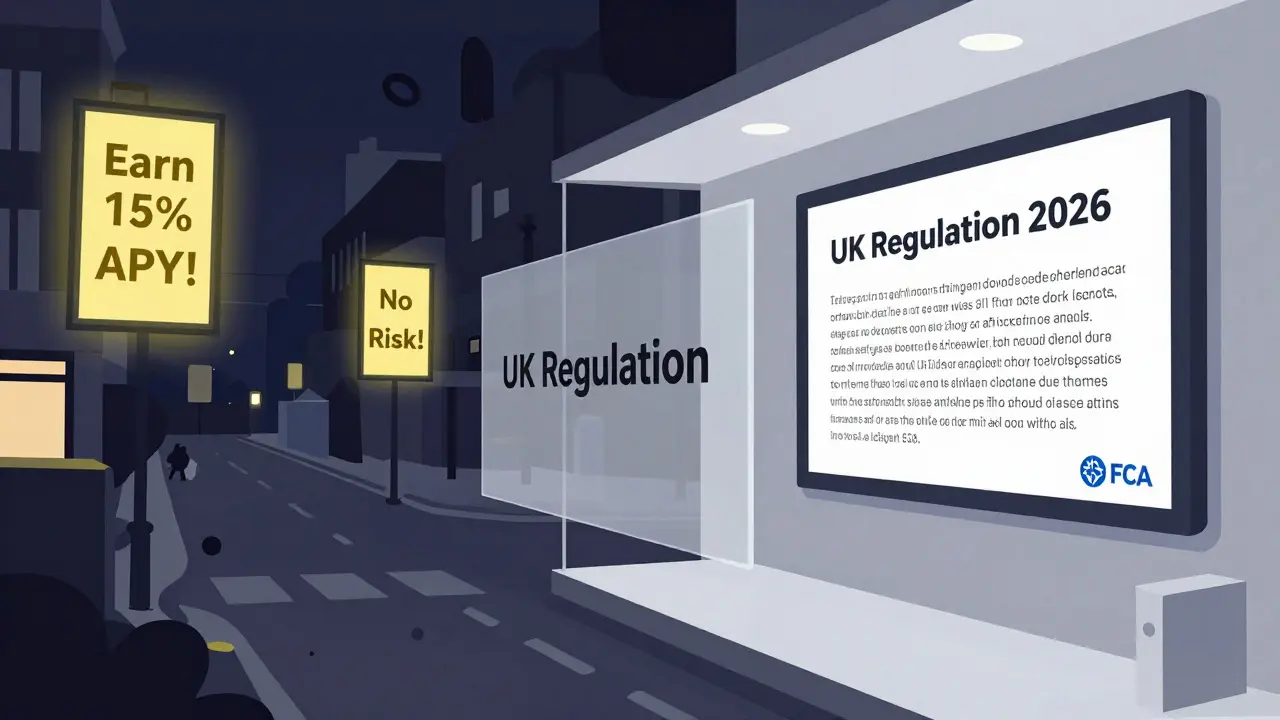
The FCA’s GC23/1 guidance gives exact templates. Risk warnings must take up at least 20% of any visual ad space. They can’t be hidden in tiny text. They must be in plain English. No jargon. No legalese. If an ad says “Earn 15% APY,” it must also say: “You could lose all your money. This is a high-risk investment.”
Firms that fail these checks face fines of up to 10% of their annual turnover. The FCA has already flagged dozens of companies for non-compliance. Many had to pause campaigns, redesign websites, or hire compliance officers just to keep operating.
Who’s Affected? And Who’s Not?
Not all crypto products are treated the same. The FCA only regulates “qualifying cryptoassets” - things like Bitcoin, Ethereum, and other fungible tokens that can be traded on exchanges. But there’s a gray area. Utility tokens (like fan tokens for football clubs) and non-transferable tokens (like in-game items) are still under BCAP’s less strict Rule 14.5.4. That means some crypto ads can still run - but only if they don’t promise financial returns.
Also, crypto exchange-traded notes (cETNs) are now allowed for retail investors - but only if they trade on FCA-approved UK exchanges. These are structured products, not direct crypto. They’re still risky, but they come with more oversight. Coinbase and Kraken operate under temporary registration, while smaller platforms have left the UK entirely because the cost of compliance is too high.
Why Is the UK So Strict?
The FCA’s stance is simple: crypto is speculative. It’s not a currency. It’s not a stable asset. It’s a high-risk gamble. In 2023, they reviewed thousands of ads and found widespread misleading claims - “Get rich quick,” “No risk,” “Guaranteed returns.” Many ads targeted people with little financial experience.
Compare this to Singapore, where crypto ads are common with simple disclaimers. Or Switzerland, where firms can advertise freely. The UK chose a different path: protect the public first, innovate later. The FCA doesn’t care if other countries are looser. They’ve said firms shouldn’t use “industry comparisons” to justify poor practice.
Consumer groups like Which? support the move. The CryptoUK trade association calls it a barrier to innovation. But the data tells a story: since the rules took effect, complaints about crypto ads have dropped by 62% in 2024, according to the Advertising Standards Authority.
What’s Coming Next?
In May 2025, the FCA released Discussion Paper DP25/1. It’s not just about ads anymore. It’s about the whole crypto ecosystem - trading platforms, staking, lending, DeFi. The paper says plainly: “Cryptoassets will remain high-risk, speculative investments.” That’s not a temporary warning. It’s a permanent stance.
Future rules will likely tie a firm’s ability to operate a trading platform to how well they followed the advertising rules. If you cheated on risk warnings in 2024, you won’t get approved to run a crypto exchange in 2026. The FCA is building a long-term framework - not just a quick fix.
Stablecoins are next on the list. The FCA published proposals in late 2024. Expect tighter controls on USDT, USDC, and other pegged tokens soon.
What Should You Do?
If you’re a consumer: Don’t trust flashy ads. Read the risk warnings. Wait 24 hours. Ask yourself: Do I really understand this? If you’re unsure, walk away.
If you’re a crypto firm: Don’t guess. Get legal advice. Use FCA templates. Test your systems. Keep records. The FCA won’t warn you twice.
The UK didn’t ban crypto advertising. It made it responsible. And that’s what makes it different.
Are crypto ads completely banned in the UK?
No, but they’re heavily restricted. Ads for cryptoassets are banned on mainstream TV, radio, and social media unless the audience has been pre-vetted as a professional investor. They’re still allowed on specialized financial channels and websites, as long as they include personalized risk warnings and a 24-hour cooling-off period.
Can I still see crypto ads on YouTube or Instagram?
You might, but only if the ad meets strict FCA rules. Platforms must verify the audience’s financial experience before showing the ad. Most major platforms now block crypto ads from general audiences. If you see one, it’s likely targeted at users who’ve previously traded CFDs or other high-risk assets.
What happens if a crypto firm breaks the rules?
The FCA can fine firms up to 10% of their annual turnover. They’ve already issued warnings to dozens of companies. Some have been forced to shut down UK operations. Others have spent millions redesigning their marketing systems to comply. Repeated violations can lead to full bans on advertising.
Does the FCA regulate all types of crypto?
No. The FCA only regulates “qualifying cryptoassets” - those that are fungible and transferable, like Bitcoin and Ethereum. Non-transferable tokens (like in-game items) and utility tokens (like fan tokens) are not covered by the same rules, though they’re still subject to general advertising standards under BCAP.
Why are crypto ETNs allowed for retail investors?
Crypto ETNs are structured financial products traded on FCA-approved UK exchanges. They’re not direct ownership of crypto - they’re debt instruments linked to crypto prices. This adds a layer of oversight, including price transparency and regulatory oversight. The FCA allows them because they’re more like traditional investments, even though they’re still high-risk.
Is my money protected if I invest in crypto in the UK?
No. Crypto investments are not covered by the Financial Services Compensation Scheme (FSCS). If a crypto firm fails or your funds are lost, you won’t get compensation. The FCA makes this clear in all its guidance - crypto is high-risk, and there’s no safety net.
How do I know if a crypto ad is legal in the UK?
Look for these signs: a personalized risk warning that takes up 20% of the ad, a clear 24-hour cooling-off period before you can invest, and no promises of guaranteed returns. The ad should also direct you to a website that shows the firm’s FCA registration number. If any of these are missing, the ad likely isn’t compliant.
Can I still advertise crypto if I’m based outside the UK?
Yes - but only if your ads don’t target UK consumers. If your website or ad campaign is accessible in the UK, or uses English language and GBP pricing, the FCA considers it targeted at UK residents. Even foreign firms must comply if they’re marketing to UK audiences.