Remember the early days of NFTs? You bought a digital collectible on Ethereum, and that was it. It lived there. If you wanted to show it off in a Solana-based game or trade it on a Polygon marketplace, you were stuck. The market fragmented into silos, killing liquidity and frustrating collectors. But as we move through 2026, that isolation is disappearing. Cross-Chain NFT Standards have emerged as the backbone of a unified digital asset economy. These protocols don't just move tokens; they preserve provenance, metadata, and functionality across disparate networks.
If you're an investor, developer, or collector, understanding these standards isn't optional anymore-it's essential for navigating where value flows next. Let's break down how this technology works, which standards are winning, and what it means for your portfolio.
The Problem With Siloed Blockchains
For years, blockchains operated like closed gardens. Ethereum had its high-value art; Solana had its fast gaming assets; Bitcoin held its rare ordinals. Moving an asset between them usually meant "wrapping" it-locking the original token on Chain A and minting a synthetic version on Chain B. This created two major issues: security risks and broken utility.
Wrapped NFTs often lost their interactive elements. Imagine transferring a generative art piece that relies on real-time data feeds. In a wrapped model, those connections frequently snapped. Furthermore, if the bridge holding the original asset got hacked, your synthetic token became worthless. This friction stifled adoption. Institutional players, who care deeply about audit trails and legal ownership, refused to touch wrapped assets. They needed native transfer capabilities-where the asset itself moves, not just a shadow copy.
This demand drove the development of sophisticated interoperability layers. We aren't just talking about simple bridges anymore. We're looking at protocols that handle compliance, identity verification, and data synchronization simultaneously.
Leading Cross-Chain Protocols in 2026
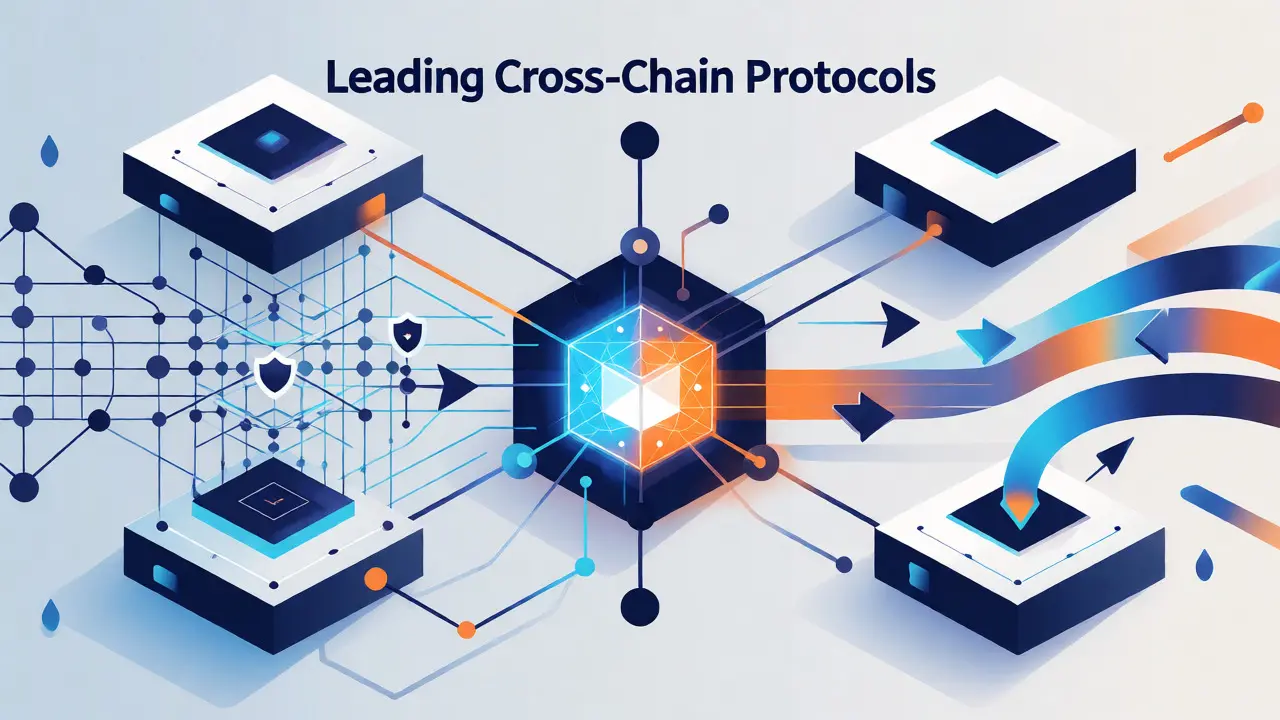
Three main contenders dominate the landscape today: Chainlink’s CCIP, the ERC-7683 standard, and Symbiosis Finance. Each solves the problem differently, targeting specific user needs.
Chainlink CCIP (Cross-Chain Interoperability Protocol) has become the institutional favorite. Released version 2.1 in January 2026, it supports over 30 networks, including Ethereum, Solana, Cosmos, and Aptos. Its superpower is the Automated Compliance Engine (ACE). This feature ensures that when an NFT moves from, say, Ethereum to a private enterprise chain, it automatically checks regulatory rules. Did the buyer pass KYC? Is the asset allowed in that jurisdiction? CCIP handles this on-chain. For high-value transactions above $50,000, this reliability is non-negotiable.
On the other end of the spectrum is ERC-7683. Ratified in late 2025, this standard focuses on "intent-centric" transfers. Instead of managing complex liquidity pools, users simply state what they want (e.g., "I want to move my NFT to Solana"). Fillers compete to execute this intent most efficiently. This reduces slippage to under 0.4% and eliminates the need for wrapped tokens entirely. It’s ideal for retail traders who want speed and low fees without worrying about underlying liquidity mechanics.
Then there’s Symbiosis Finance, which blends bridging with automated market maker (AMM) functionality. Its standout feature is Bitcoin integration. While most EVM-focused bridges ignore Bitcoin, Symbiosis allows NFTs to move between Bitcoin and smart contract chains using Multi-Party Computation (MPC) security. This is crucial for the growing Ordinals ecosystem, allowing rare Bitcoin NFTs to interact with DeFi applications on other chains.
Native Transfers vs. Wrapped Tokens
The biggest shift in 2026 is the death of the wrapped token model for serious applications. Why? Because wrapped tokens create artificial scarcity and verification headaches.
| Feature | Wrapped Token Model (Legacy) | Native Transfer Standard (CCIP/ERC-7683) |
|---|---|---|
| Asset Representation | Synthetic IOU token | Original asset moved or mirrored natively |
| Provenance Verification | Complex; requires trusting the bridge | Direct cryptographic proof |
| Metadata Integrity | Frequently breaks animations/data feeds | Maintained via standardized sync |
| Institutional Trust | Low; high counterparty risk | High; audited and compliant |
| Cost Efficiency | Variable; depends on bridge liquidity | Predictable; optimized routing |
Data backs this up. MIT Digital Currency Initiative found that native transfer protocols reduced provenance disputes by 94.3%. When you own a piece of digital history, you can’t afford ambiguity. Institutional platforms processing six-figure transactions have migrated to native standards at a rate of 73% since late 2025. The message is clear: if it’s not native, it’s risky.
Real-World Applications Driving Adoption
So, who is actually using this tech? It’s not just speculators. Gaming is the largest driver, accounting for nearly 59% of cross-chain NFT transfers. Games like Star Atlas and Illuvium allow players to take assets earned on one chain into another game environment. Without cross-chain standards, each game would be a walled garden, limiting player engagement and asset utility.
Enterprise use cases are also exploding. Real estate tokenization platforms now use cross-chain NFTs for property deeds. In 2025 alone, $417 million in property transactions utilized these standards across 12 jurisdictions. This allows a deed minted on a private permissioned chain to be traded on public networks, increasing liquidity for illiquid assets.
Art markets have also adapted. Platforms like SuperRare use CCIP to verify collector accreditation. If you’re buying a $100,000 piece of art, the system checks your location and status instantly. This seamless compliance removes friction for global buyers, making high-end digital art truly borderless.

Challenges and Technical Hurdles
It’s not all smooth sailing. Developers still face significant hurdles. Metadata preservation remains the top complaint. About 42% of negative user feedback cites broken animations or missing interactive elements after transfers. Generative art, which often relies on external APIs or complex JSON structures, struggles most when moving between chains with different data storage models.
Royalty enforcement is another pain point. Automatic royalty payments fail in roughly 63% of cross-chain scenarios. Smart contracts on different chains don’t always speak the same language regarding payment distribution. While new standards aim to fix this, many current implementations require manual intervention or third-party escrow services.
Security is paramount. Replay attacks-where a transaction is duplicated on another chain-are a known vulnerability. During network congestion, stress tests show that 62% of older protocols fail to prevent these duplicates. Newer standards incorporate nonce management and unique transaction IDs to mitigate this, but users must ensure they are interacting with updated interfaces.
The Future: Chain Abstraction
We are heading toward "chain abstraction." Think of TCP/IP in the early internet. Users didn’t care about packet switching; they just wanted websites to load. Similarly, future NFT users won’t care if their asset lives on Ethereum, Solana, or Base. The infrastructure will handle it invisibly.
By 2027, analysts predict cross-chain NFT transaction volume will hit $8.2 billion. Consolidation is inevitable. Messari Crypto forecasts that 83% of the market will coalesce around a few dominant standards like CCIP and ERC-7683 by 2028. The era of fragmented, incompatible networks is ending. What’s left is a unified layer where digital ownership is fluid, verifiable, and globally accessible.
For developers, the learning curve is steep but manageable. Mastering TypeScript and Rust is key. For investors, the takeaway is simple: look for projects leveraging native transfer standards. Avoid legacy wrapped assets unless they offer immediate utility that outweighs the risk. The winners in this space will be those who prioritize interoperability as a core feature, not an afterthought.
What is the main difference between wrapped NFTs and native cross-chain NFTs?
Wrapped NFTs are synthetic representations locked in a bridge, while native cross-chain NFTs maintain their original identity and metadata integrity across chains. Native transfers eliminate counterparty risk associated with the bridge custodian and preserve functional attributes like animations and smart contract logic.
Which cross-chain standard is best for high-value institutional NFTs?
Chainlink’s CCIP is currently the preferred choice for institutional use. Its Automated Compliance Engine (ACE) provides built-in regulatory checks and identity verification, ensuring that high-value transactions meet legal requirements across different jurisdictions.
How does ERC-7683 improve NFT transfers?
ERC-7683 uses an intent-centric architecture. Users declare their desired outcome, and fillers compete to execute the transfer efficiently. This reduces slippage, eliminates the need for wrapped tokens, and simplifies the user experience by abstracting away liquidity management complexities.
Why do metadata issues occur during cross-chain transfers?
Different blockchains store and interpret metadata differently. Complex generative art may rely on external data feeds or specific JSON structures that don't translate perfectly between chains. Newer standards are improving this, but it remains a common technical challenge requiring careful implementation.
Is Bitcoin supported by cross-chain NFT standards?
Yes, specifically through protocols like Symbiosis Finance. Using Multi-Party Computation (MPC) security, Symbiosis enables the movement of Bitcoin-based NFTs (Ordinals) to and from smart contract chains, facilitating interaction with broader DeFi ecosystems.