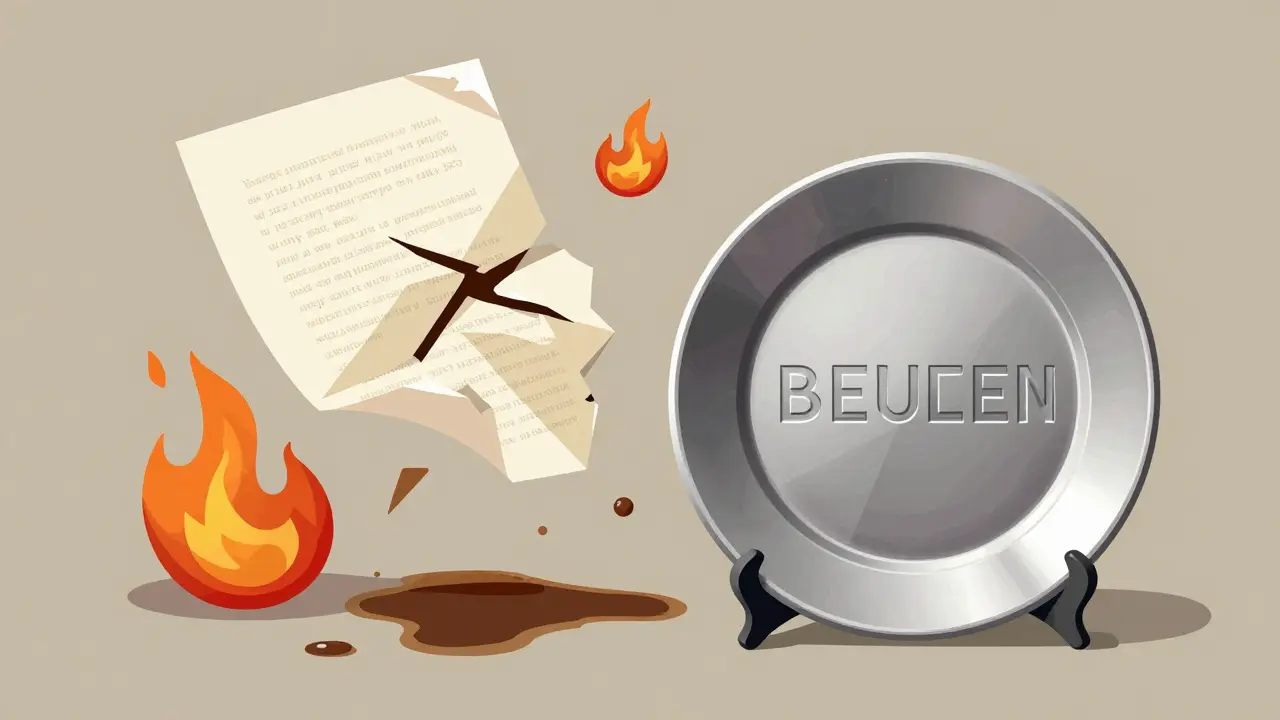
Imagine locking your house with a key you can’t remember, and then realizing no one else has a copy-not your neighbor, not the police, not even the lock company. That’s what happens when you mess up your cryptocurrency seed phrase. There’s no customer service line. No ‘forgot password?’ button. Just silence-and your coins, gone forever.
Over 78% of cryptocurrency losses in 2023 came from bad seed phrase handling. Not hacking. Not scams. Just people writing it down wrong, saving it on their phone, or forgetting it existed until it was too late. And it’s not just beginners. Even experienced users make the same mistakes over and over.
Writing It Down on Regular Paper
You think a sticky note or a piece of printer paper is fine? It’s not. Heat, moisture, ink fading, coffee spills, pets chewing it-these aren’t hypotheticals. Blockstream’s lab tests showed untreated paper becomes unreadable after 3.2 years on average. One user lost 14.2 ETH because a coffee stain blurred three words. Another’s seed phrase turned to dust after being stored in a damp basement for five years.
There’s a reason serious users use stainless steel plates. These aren’t fancy gadgets-they’re simple, cheap metal sheets you etch words into with a punch tool. Tested to survive 1,200°C heat and salt spray for hours, they outlast your house. Paper might feel safe because it’s not digital, but it’s fragile. Steel is durable. Choose durability.
Storing It Digitally
Screenshots. Notes apps. Cloud backups. Email attachments. Password managers. All of these are digital landmines.
Rockwallet’s 2023 testing showed unprotected digital files can be stolen in under 72 hours. Malware, phishing, SIM-swapping attacks-they don’t need to break into your wallet. They just need to find the note you saved on iCloud or Google Drive. One Reddit user lost 2.37 BTC after a hacker accessed their Apple ID through a SIM swap. The seed phrase was in a photo labeled “crypto backup.”
Even password managers aren’t safe. Dr. Emily Parker from MIT calls this a “single point of failure.” If your password manager gets breached, you lose everything. Crypto’s whole point is decentralization-no middleman. But if you’re storing your seed phrase in a system run by a company, you’ve just rebuilt the system you were trying to escape.
Typing It Wrong-Even One Letter
Seed phrases use a fixed list of 2,048 words. No made-up words. No capital letters. No punctuation. Every word must be exact. And the order? Critical.
Blockplate’s analysis of 4,321 failed recoveries found that 63.7% were checksum errors-meaning the phrase looked right, but the math didn’t add up. Why? Because someone swapped two words. Or typed “dollar” instead of “dollar.” Or missed a word entirely. The system won’t warn you. It’ll just create a different wallet. And that wallet? Empty. Your coins are still on the blockchain, but locked under a key you don’t have.
Reddit’s r/CryptoCurrency saw 247 recovery failures in just three months in 2024. Of those, 32% were misspelled words, 29% were wrong order, and 19% had the wrong number of words. You don’t need to be tech-savvy to make this mistake. You just need to be tired. Or distracted. Or rushing.

Not Testing the Recovery
Most people never test their backup. They write it down, tuck it away, and assume it’ll work when needed. Then, years later, they try to recover-and it fails.
Jade Wallet’s 2023 study found that 67.4% of new users skip testing. And of those who finally try to recover after years, 58.3% discover their backup has errors. That’s not a theory. That’s data. People don’t realize their handwritten phrase has smudged, or they misremembered the third word, or they wrote “tiger” instead of “tiger” (yes, that’s a real BIP-39 word).
Here’s what you do: Put 0.001 BTC (less than $100) into a new wallet. Write down the seed phrase. Then, wipe the wallet. Restore it using your backup. Confirm the 0.001 BTC shows up. Do this before you put in any real money. If it doesn’t work, fix it now-not when you’ve got 10 BTC at stake.
Generating It on a Connected Device
Never, ever generate your seed phrase on a phone, laptop, or tablet that’s connected to the internet.
Blockplate’s 2024 honeypot experiment simulated 1,247 wallet creations on internet-connected devices. The result? 12.9 times more compromise than on air-gapped devices. Malware can log keystrokes, capture screenshots, or intercept the phrase before it’s even written down. Even if you think you’re safe-your antivirus doesn’t catch everything. Your browser extension? Could be malicious. Your Wi-Fi? Could be compromised.
Use a hardware wallet. Or a dedicated offline device. Or even a cheap, used tablet you never connect to Wi-Fi. The point is: no network. No risk. Your seed phrase should never touch the internet-not even for a second.
Sharing It With Anyone
You trust your spouse. Your sibling. Your best friend. You think, “They’d never steal it.” But you’re not thinking about what happens if they get hacked. Or if they accidentally leave it on a sticky note. Or if they get pressured by someone else.
Chainalysis found that 83.1% of compromised wallets happened because someone shared their seed phrase. Family members were the #1 cause-41.2% of cases. A wife gave it to her husband “just in case.” He lost it. A son showed his dad the phrase to “prove he had crypto.” Dad screenshot it. Dad’s phone got infected. Gone.
There is no safe person. No trusted party. No emergency contact who should ever see your seed phrase. If you want to leave crypto to someone, use a multisig wallet with legal documentation. Not a handwritten note.

Confusing Seed Phrase With Passphrase
A passphrase (sometimes called a 13th or 25th word) is an extra layer of security. It turns your seed phrase into a completely different wallet. But here’s the catch: if you forget the passphrase, you lose access to that wallet-even if your seed phrase is perfect.
RecoverySeed.cz’s 2024 data shows 34.8% of users who used passphrases didn’t write them down properly. They assumed they’d remember. They didn’t. And now, millions in crypto are locked away, forever unreachable.
Passphrases are optional. But if you use one, treat it like your seed phrase: write it down separately, store it in a different place, test it. And never, ever combine them in the same note.
Buying Fake Hardware Wallets
Amazon, eBay, AliExpress-they’re full of fake hardware wallets. Devices that look like Ledger or Trezor, but are designed to steal your seed phrase during setup.
The Blockchain Transparency Institute found 237 counterfeit wallets sold online in Q1 2024 alone-a 42.3% jump from last year. These devices ask you to enter your seed phrase during “recovery.” They record it. Then, the thief drains the wallet. You think you’re safe because you bought a “hardware wallet.” You’re not.
Only buy from official sites. Ledger.com. Trezor.io. Blockstream.com. If it’s cheaper than retail, it’s fake. If it’s sold on a marketplace with no verified seller, it’s dangerous. Don’t risk your life savings for a $20 “deal.”
What to Do Instead
Here’s the simple, proven plan:
- Get a hardware wallet from a trusted brand (Ledger, Trezor, Blockstream Jade).
- Turn off Wi-Fi and Bluetooth on your phone or computer.
- Generate the seed phrase on the device-never on your phone or laptop.
- Write it down on a stainless steel plate. Use a punch tool. Don’t use pen and paper.
- Test the recovery with 0.001 BTC. Confirm it works.
- Store the steel plate in a fireproof safe, separate from your computer and phone.
- Never, ever share it. Not with family. Not with friends. Not with support staff.
- If you use a passphrase, write it down separately. Store it in a different location.
This isn’t about being paranoid. It’s about being responsible. Crypto gives you control. But control means responsibility. No one else can fix your mistakes. Only you can prevent them.
By 2026, experts project seed phrase losses will drop from 23.7% to 14.2% as people learn. But that still means $84.3 billion lost every year. Don’t be part of that number. Get it right the first time.
Can I memorize my seed phrase instead of writing it down?
No. Human memory can reliably hold only 7±2 items. A 12- or 24-word seed phrase is too long to memorize accurately under stress. Even if you think you remember it now, you’ll forget a word under pressure-like when you’re trying to recover funds after a device failure. Writing it down on durable media is the only reliable method.
What happens if I lose my seed phrase but still have my hardware wallet?
You lose access to your funds. The hardware wallet is just a tool-it doesn’t store your crypto. Your seed phrase is the key. Without it, even the original device can’t recover your assets. No manufacturer can help you. No blockchain can reset it. It’s permanently gone.
Is it safe to store my seed phrase in a digital vault like a safe deposit box?
Only if the vault contains a physical copy on steel or engraved metal. Digital backups stored in cloud vaults, encrypted drives, or password managers are still vulnerable to hacking, ransomware, or service shutdowns. Physical, offline, and tamper-resistant storage is the only secure option.
Can I use the same seed phrase for multiple wallets?
Technically yes, but it’s dangerous. If one wallet gets compromised, all wallets using that seed phrase are at risk. Each wallet should have its own unique seed phrase. Using one phrase across multiple wallets creates a single point of failure-defeating the purpose of decentralization.
Do I need to update my seed phrase over time?
No. A seed phrase doesn’t expire. Once generated, it works forever-assuming you keep it secure. The only reason to generate a new one is if you suspect it’s been compromised. Never change it just because you’re “worried.” Your original phrase is still valid.
What’s the difference between a 12-word and 24-word seed phrase?
A 12-word phrase offers 128 bits of security; a 24-word phrase offers 256 bits. Both are currently unbreakable by any known technology. The 24-word version is more secure, but 12 words are still considered safe for most users. The real issue isn’t length-it’s how you store and handle it. A poorly stored 24-word phrase is far riskier than a well-protected 12-word one.
Can a wallet provider help me recover my seed phrase?
No. No legitimate wallet provider can recover your seed phrase. If someone claims they can-whether it’s a support agent, a YouTube tutorial, or a chatbot-they’re lying. This is a common scam. Blockchain technology is designed so that only you hold the key. No one else can access it-not even the company that made your wallet.
roxanne nott
December 20, 2025 AT 15:28paper is for grocery lists not your life savings bro
Dusty Rogers
December 21, 2025 AT 03:30just got my steel plate last week. spent $15 on a punch tool from Amazon. wrote it out by hand, then punched it. tested with 0.001 btc. felt like a wizard. no more sweating over sticky notes.
chris yusunas
December 22, 2025 AT 12:16in nigeria we say 'if you trust your phone with your seed, you trust your money to a ghost'. i seen too many guys lose everything because they took a screenshot for 'easy access'. dumb.
Mmathapelo Ndlovu
December 23, 2025 AT 06:18i cried when i lost my first wallet because i thought i remembered it. turned out i mixed up 'tiger' and 'tiger'-same spelling, different word in the list. the system didn’t care. i lost $12k. now i use steel. always test. never assume.
Dustin Bright
December 23, 2025 AT 13:00just got a hardware wallet and wrote my phrase on steel. i’m not gonna lie, i felt like a prepper. but honestly? it’s peace of mind. 🛡️
Alison Fenske
December 24, 2025 AT 04:47my cousin gave me his seed phrase 'to help me out'-i told him no. he called me paranoid. two weeks later his phone got ransomed. he lost everything. i didn’t even need to say 'i told you so'.
Helen Pieracacos
December 24, 2025 AT 05:56oh wow, you mean i shouldn’t email my seed phrase to myself with the subject line 'my crypto backup'? who knew.
Naman Modi
December 25, 2025 AT 18:40steel plates are for normies. i memorize mine. it’s not that hard.
Craig Fraser
December 27, 2025 AT 18:20you’re all missing the real issue. if you’re using crypto at all, you’re already gambling. this is just a new form of self-sabotage. the system isn’t broken-you are.
Sarah Glaser
December 28, 2025 AT 21:40the real tragedy isn’t the lost coins-it’s the erosion of personal responsibility. we live in an age where people outsource their security to apps, to cloud backups, to strangers. crypto was meant to be the antidote to that. yet here we are, rebuilding the very system we swore to escape.
Sybille Wernheim
December 29, 2025 AT 08:36just wanna say-this is the most important thing i’ve read all year. if you’re new to crypto, read this twice. then print it. then put it on steel. you’re welcome.
Kevin Karpiak
December 31, 2025 AT 07:08you people are ridiculous. the government should regulate seed phrases. we need a federal backup system. it’s irresponsible to leave people to their own devices.
Lloyd Yang
January 1, 2026 AT 03:30let me tell you about my buddy who used a password manager for his seed phrase. he thought it was 'encrypted so it’s safe'. then his laptop got stolen. the thief didn’t even crack the password manager-he just found the backup file he’d uploaded to Dropbox labeled 'crypto master key'. lost 47 btc. the worst part? he still doesn’t get it. he says 'but it was encrypted!' like that’s a magic shield. encryption doesn’t save you from stupidity. you need to stop storing it anywhere digital. period. if you’re using a cloud service, you’re not owning your crypto-you’re renting it from someone else. and they don’t care if you lose it. your wallet provider? they’re not your friend. they’re a business. your seed phrase? that’s your soul. don’t let it leave your hands.
Melissa Black
January 2, 2026 AT 09:19the 12 vs 24-word debate is a distraction. entropy is entropy. 128-bit security is cryptographically sound. the real vulnerability is human operational security. your storage medium, your handling protocol, your psychological bias toward convenience-all of these are attack surfaces. the algorithm is fine. the user is the exploit.
Zavier McGuire
January 3, 2026 AT 12:01why are we even talking about this like it’s a mystery? if you don’t know how to handle your seed phrase you shouldn’t be holding crypto. it’s not rocket science. it’s basic common sense. stop making it complicated.
Collin Crawford
January 3, 2026 AT 23:54the notion that steel plates are 'durable' is misleading. they can be confiscated, stolen, or destroyed by physical force. true security lies in decentralization of storage-multiple encrypted shards across geographically dispersed locations, each requiring a separate biometric key. anything less is theatrical.
Lloyd Yang
January 5, 2026 AT 21:00you’re right, Collin. steel is just one layer. i’ve got mine on steel, in a fireproof safe, and i’ve also split the phrase into three parts and stored them with three different trusted family members who don’t know what they’re holding. each part is encoded with a simple cipher only i know. if i die, they each get a letter with instructions. no one has the full key. that’s real decentralization. not just buying a shiny metal plate and calling it done.