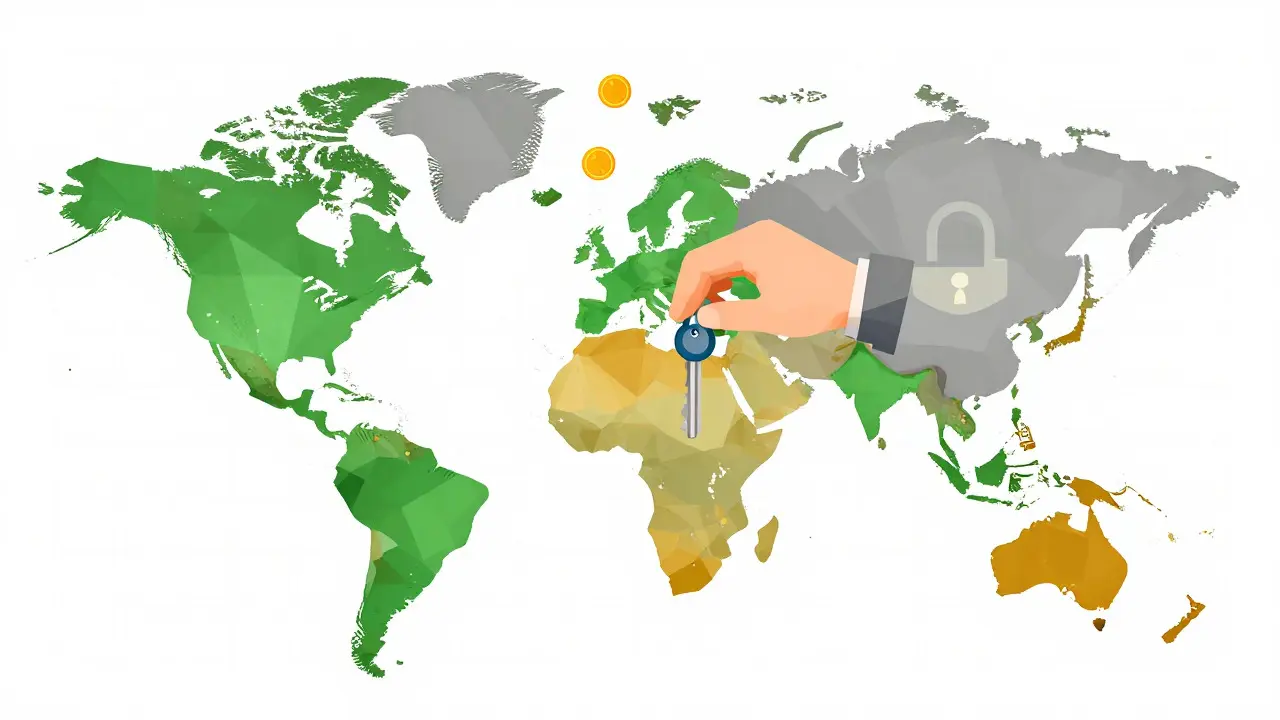
Trying to buy Bitcoin in Pakistan only to find the button grayed out? Or maybe you're in the UAE and confused why Apple Pay works but bank transfers don't. If you've ever hit a wall on Coinbase is a major U.S.-based cryptocurrency exchange that facilitates fiat-to-crypto trading and self-custody wallet services across global markets., you aren't alone. The platform serves over 100 countries, but its features vary wildly depending on where you live. It’s not just about whether the app opens; it’s about what you can actually do inside it. Some places get full access to bank deposits, while others are stuck with limited options or forced onto self-custody wallets. Understanding these geographic crypto restrictions saves you time, fees, and the frustration of failed transactions.
The core issue isn't arbitrary blocking. It’s compliance. Coinbase operates under strict U.S. regulations, primarily driven by the Office of Foreign Assets Control (OFAC) is a bureau of the U.S. Department of the Treasury responsible for administering and enforcing economic and trade sanctions.. When the U.S. government sanctions a country or region, Coinbase often has to cut off fiat currency on-ramps to avoid massive fines. This creates a two-tier system: the full Coinbase App is the primary user interface allowing users to buy, sell, and hold cryptocurrencies using fiat currencies like USD or EUR. for regulated markets, and the Coinbase Wallet is a non-custodial digital wallet that allows users to store assets and interact with decentralized applications without requiring fiat deposits. for almost everyone else. Knowing which tier you fall into is the first step to navigating the platform effectively.
How Coinbase Determines Your Access
It might seem like magic when the app blocks you, but the technical enforcement is quite straightforward. Coinbase uses a combination of IP geolocation and Know Your Customer (KYC) verification to map your eligibility. Your IP address gives a rough idea of your location, but the real gatekeeper is your KYC data. You need to provide a government-issued ID and proof of address that matches a supported jurisdiction. If your documents say you’re in a restricted zone, the fiat features disappear, even if your IP says otherwise. However, this mismatch can backfire. We’ve seen cases where users in the UAE lost funds because they used a VPN to bypass checks, triggering account freezes due to IP mismatches. The system is designed to be consistent, so playing games with your location usually leads to more problems than it solves.
There’s also a regulatory sandboxing aspect. In Europe, for instance, compliance with the Markets in Crypto-Assets (MiCA) regulation has expanded access to 30 nations, but it required shifting legal entities. For example, users in Malta, Iceland, Liechtenstein, and Hungary transitioned from Coinbase Europe Limited to Coinbase Luxembourg S.A. effective August 18, 2025. These backend changes mean that while your experience looks similar, the legal framework governing your account has shifted. In the U.S., the recent SEC litigation has kept the platform on high alert, potentially tightening rules further. So, your access isn't static; it evolves as laws change in both your home country and Washington D.C.
Full Access vs. Limited Access: The Key Differences
The distinction between the Coinbase App and Coinbase Wallet is the most critical factor for most users. The App is where the money moves. It supports fiat deposits via ACH, SEPA, debit cards, and even PayPal in many regions. If you’re in Germany, you can wire €10,000 in via SEPA and have it ready in hours. If you’re in the U.S., you can use Apple Pay or bank transfers seamlessly. But if you’re in a country where the App is restricted, you’re left with the Wallet. The Wallet is powerful-it supports over 5,500 tokens and lets you interact with DeFi apps-but it doesn’t let you deposit dollars or euros directly. You have to transfer crypto from another source. This means if you want to start from zero, you need an alternative way to get your first Bitcoin, often through peer-to-peer (P2P) exchanges or local banks, which adds complexity and risk.
| Feature | Full Access Regions (e.g., U.S., UK, Germany) | Limited Access Regions (e.g., UAE, Singapore) | Restricted/Sanctioned Regions (e.g., Russia, Crimea) |
|---|---|---|---|
| Fiat Deposits (USD/EUR) | Yes (Bank, Card, Apple Pay) | Possible (Limited methods like Apple Pay only) | No |
| Coinbase App Availability | Full Functionality | Partial or Blocked | Blocked |
| Coinbase Wallet Availability | Yes | Yes | Yes (Self-custody only) |
| KYC Requirements | Standard ID + Address | Strict ID Verification | Often Unavailable |
| Transaction Limits (Daily) | Up to $50,000 (Verified) | Variable, often lower | N/A |
Country-Specific Scenarios and Workarounds
Let’s look at specific examples to make this concrete. Take Pakistan is a South Asian country with a large unbanked population seeking digital financial tools.. For years, access was murky. Now, the situation is clear: the App is largely restricted for fiat on-ramps, but the Wallet works. Users report having to use P2P platforms with an 8% premium to get their initial crypto. It’s expensive, but it works. Contrast this with Germany is a European nation with robust BaFin licensing for financial services.. Here, Coinbase holds a full license. You get seamless SEPA integration, high limits, and reliable support. The difference is night and day. Then there’s the United Arab Emirates (UAE). Data suggests conflicting information online, but current status indicates limited access. You can use Apple Pay to top up, but traditional bank transfers might be blocked. This partial access confuses many new users who assume 'restricted' means 'no access.' It doesn’t. It means 'pick your battles carefully.'
In Russia is a country subject to extensive U.S. economic sanctions following the 2022 geopolitical conflicts., the story is different. Post-February 2022, all fiat services ceased. You can still open a Wallet and send/receive crypto if you already have some, but you can’t buy directly with Rubles. This pushes Russian users toward local exchanges or OTC desks. Meanwhile, in India is a major emerging market with ongoing regulatory consultations regarding cryptocurrency taxation and registration., the landscape is shifting. After previous restrictions, Coinbase attempted re-registration with the Reserve Bank of India (RBI) in early 2025. While not fully resolved, the possibility of deregistration or approval keeps Indian traders hopeful. Until then, many rely on international cards or P2P networks. These examples show that 'restricted' is a spectrum, not a binary switch.
Why Do These Restrictions Exist?
It’s easy to blame the company, but the drivers are external. The primary force is OFAC compliance. If the U.S. Treasury designates a country as sanctioned, doing business there becomes legally risky for any U.S. entity. Coinbase, being a Nasdaq-listed company (NASDAQ: COIN), plays it safe. They align their service map precisely with the SDN List. This explains why Crimea is permanently excluded and why Russia saw immediate cuts. Beyond sanctions, there’s local regulation. In Europe, MiCA created a unified rulebook, allowing Coinbase to expand efficiently across 30 EEA nations. In Asia, fragmented rules mean they often wait for clarity rather than taking risks. The SEC lawsuit filed in June 2023 also plays a role. By targeting Coinbase’s operations as an 'unregistered national securities exchange,' the SEC pressured the company to tighten its belts globally. Every dollar spent on legal defense is a dollar not spent on expanding into risky markets.
There’s also a risk management angle. According to MIT’s Digital Currency Initiative, geo-blocking reduces illicit transaction risk by 78% in sanctioned regions. For a public company, that’s a strong incentive. Yes, it locks out millions of potential users-estimates suggest 12.7 million unbanked citizens in developing economies are affected-but it protects the bottom line from compliance fines. Critics argue this is overly broad, pointing to countries like Bangladesh that aren’t officially sanctioned but still face exclusions. Whether that’s prudent or excessive depends on your perspective. For the average user, it just means you need to check your specific status before investing time in setting up an account.
Practical Steps to Check Your Status
Don’t guess. Verify. Here’s how to determine exactly what you can do:
- Check the Help Center: Log into your account (if you have one) or visit the public FAQ section. Coinbase updated its 'Country Restrictions' page in January 2025 to include real-time status checks. Look for your specific country code.
- Attempt KYC: Start the identity verification process. If the system accepts your ID and proof of address without error, you likely have full or partial access. If it rejects you based on jurisdiction, you’re in a restricted zone.
- Test a Small Transaction: If you have access, try a minimal deposit. Sometimes features are enabled but buggy. A $10 test run confirms if the pipeline works.
- Review Local Regulations: Check if your country has banned crypto entirely (like Nigeria did in 2024, though later softened) or if it’s just Coinbase-specific. If the whole market is banned, no exchange will help.
- Consider Alternatives: If Coinbase is fully blocked, look at competitors. Binance operates in 32 more countries than Coinbase, including Canada and the Netherlands. Kraken offers fiat services in 55 countries. MetaMask is unrestricted in 195+ countries for self-custody.
Keep in mind that transaction limits vary. New accounts in high-risk jurisdictions might face 24-72 hour holds on withdrawals. Fully verified users in stable markets can move up to $50,000 daily. Always read the fine print in the User Agreement, specifically Section 1, which details eligibility requirements. It explicitly states that services are subject to termination 'as required by law, regulation or any court or other authority.' That clause is your warning sign that things can change overnight.
Frequently Asked Questions
Can I use Coinbase Wallet in restricted countries?
Yes, generally. Coinbase Wallet is a self-custody tool that operates globally except in heavily sanctioned zones. It allows you to store crypto and interact with dApps, but it does not allow direct fiat currency deposits. You must acquire crypto elsewhere and transfer it in.
Why is my Coinbase App blocked even though I have a valid ID?
This usually happens if your country of residence is not on the list of supported jurisdictions for fiat services. Even with a valid passport, if the local regulatory environment is unstable or sanctioned, the App may restrict fiat on-ramps. Check the specific country list in the Help Center.
Does using a VPN fix geographic restrictions?
Rarely, and it’s risky. Coinbase uses IP geolocation combined with KYC data. If your ID says you’re in a restricted country but your IP says you’re in the U.S., the system may flag your account for review or freeze assets. It’s better to use official channels or alternative exchanges.
Which countries have full Coinbase access?
Full access includes the U.S., U.K., Germany, France, Singapore, and most of the European Economic Area (EEA) under MiCA compliance. These regions support bank transfers, card payments, and high transaction limits.
What happened to Coinbase in Russia?
Following the 2022 U.S. sanctions, Coinbase ceased all fiat currency services in Russia. Users can still use the self-custody Wallet to manage existing assets, but buying crypto directly with Rubles is no longer possible. Many users switched to local exchanges or P2P markets.
Is Coinbase available in India?
Access in India has been inconsistent. After previous restrictions, Coinbase sought re-registration with the RBI in 2025. As of mid-2026, the status remains fluid. Users should check the latest updates, as full fiat access may not yet be restored.