
Imagine waking up in a jurisdiction where your cryptocurrency gains are taxed at zero percent. For many digital asset holders, this isn't just a fantasy; it is a legal reality available through strategic immigration planning. As global regulators tighten their grip on crypto reporting, investors are looking beyond simple offshore accounts. They are seeking full residency or citizenship in places that welcome blockchain wealth.
This strategy involves more than just buying a passport. It requires navigating complex tax laws, understanding physical presence rules, and managing the risk of exit taxes if you decide to leave your home country later. The landscape has shifted dramatically since 2024. What used to be a gray area is now a structured, albeit expensive, path to financial optimization. Here is how citizenship and residency programs work for reducing your crypto tax burden in 2026.
The Core Strategy: Residency vs. Citizenship
Before picking a destination, you need to understand the difference between Residency by Investment (RBI) and Citizenship by Investment (CBI). These two paths offer different levels of access and tax benefits.
RBI programs grant you the right to live in a country permanently without requiring you to give up your current citizenship. This is often the preferred route for crypto investors because it allows you to maintain your original passport while accessing favorable tax regimes. You usually need to prove substantial financial assets or make a significant property purchase.
CBI programs go further. They offer you a second passport and full citizenship rights. This provides greater travel freedom and political stability. However, these programs often come with higher upfront costs and stricter due diligence processes. For crypto holders, the key advantage is the ability to structure your global income under a new legal identity that may not tax capital gains from foreign sources.
| Feature | Residency by Investment (RBI) | Citizenship by Investment (CBI) |
|---|---|---|
| Tax Benefit | Often territorial or low-rate | Varies by jurisdiction |
| Time to Process | 3-12 months | 6-24 months |
| Cost Range | $100k - $500k+ | $100k - $1M+ |
| Travel Freedom | Visa-free to limited countries | Visa-free to 140+ countries |
| Crypto Acceptance | High (if converted/evidenced) | Moderate (strict source checks) |
Puerto Rico Act 60: The US Citizen’s Gateway
If you are a US citizen, renouncing your passport is a nuclear option. It triggers an Exit Tax calculated as if you sold all your assets on the day before leaving. For anyone with a net worth over $2 million, this can mean paying 23.8% in taxes immediately. That is why Puerto Rico stands out as the most accessible crypto tax haven for Americans.
Puerto Rico operates under Act 60, which combines previous incentives into one powerful package. This law allows qualifying residents to pay zero percent tax on long-term capital gains. For crypto investors who have held Bitcoin or Ethereum for years, this means selling millions in assets without owing federal capital gains tax.
Here is what makes Act 60 unique:
- Zero Capital Gains Tax: Applies to gains realized after becoming a bona fide resident.
- Low Corporate Tax: If you run a mining operation or DeFi protocol, you pay only 4% corporate tax.
- No State Income Tax: Your salary is taxed at a flat 4% rate.
- Property Tax Breaks: You get a 75% exemption on state property taxes and 50% on municipal taxes.
To qualify, you must become a "bona fide resident." This doesn't mean you have to live there every single day, but you must spend more than 183 days a year in Puerto Rico. You also need to establish your economic interests there. Many crypto founders set up their management companies in San Juan to satisfy this requirement. Unlike European options, you keep your US citizenship and Social Security number, avoiding the messy exit tax entirely.
Malta: The Blockchain Island
For non-US citizens, Malta remains the gold standard for regulatory clarity. Known as the "Blockchain Island," Malta has built its entire financial infrastructure around digital assets. It offers two main pathways for high-net-worth individuals: the Malta Permanent Residence Programme (MPRP) and the Global Residence Programme (GRP).
The MPRP is ideal if you already have significant liquid assets. You don't necessarily need to invest in real estate; you can show proof of financial independence. If your wealth is in crypto, you will likely need to convert some to fiat currency to pass the strict due diligence checks. The program accepts crypto wealth if it is properly documented and traced back to legitimate sources like trading profits or early-stage investments.
The GRP offers a different angle. It targets non-domiciled individuals. Under Maltese tax law, unremitted income-money earned abroad and not brought into Malta-is not taxed. This means if you hold crypto in wallets outside of Malta and only spend what you bring in, your massive unrealized gains remain outside the tax net. You only pay tax on money you actually use in the country.
Malta also offers a Citizenship by Merit route. This is not a direct purchase. Instead, it is a reward for those who have contributed significantly to the island's economy, including the blockchain sector. If you have launched a major project or invested heavily in local infrastructure, you might qualify for naturalization after three years of residence. This is a slower path, but it grants EU citizenship, which opens doors across Europe.

Caribbean CBI Programs: Speed and Simplicity
If you want a passport quickly and don't mind living elsewhere, Caribbean nations like Vanuatu, Dominica, and St. Lucia offer straightforward CBI programs. These are popular among crypto traders who value privacy and speed over specific tax treaties.
These programs typically require a donation to a government fund or a real estate purchase. For example, Vanuatu allows you to obtain citizenship in as little as one month with a minimum contribution of around $130,000. Dominica and St. Lucia have similar structures, with processing times ranging from six to twelve months.
However, there is a catch. These islands do not always offer zero-tax status for crypto gains by default. Their appeal lies in their lack of wealth tax, inheritance tax, and capital gains tax *for residents*. But if you are a US citizen or a resident of a country with worldwide taxation (like Canada or Australia), simply holding a Caribbean passport won't erase your home country's tax bill. You must break tax residency in your home country to benefit fully. This means moving your life center to the Caribbean or another tax-friendly jurisdiction.
Due diligence is intense. Governments are wary of money laundering. You will need to provide bank statements, trade histories, and explanations for every large crypto transaction. If your coins came from a dark web marketplace or an unregulated exchange, you might be rejected. Clean records are essential.
Navigating Exit Taxes and Hidden Risks
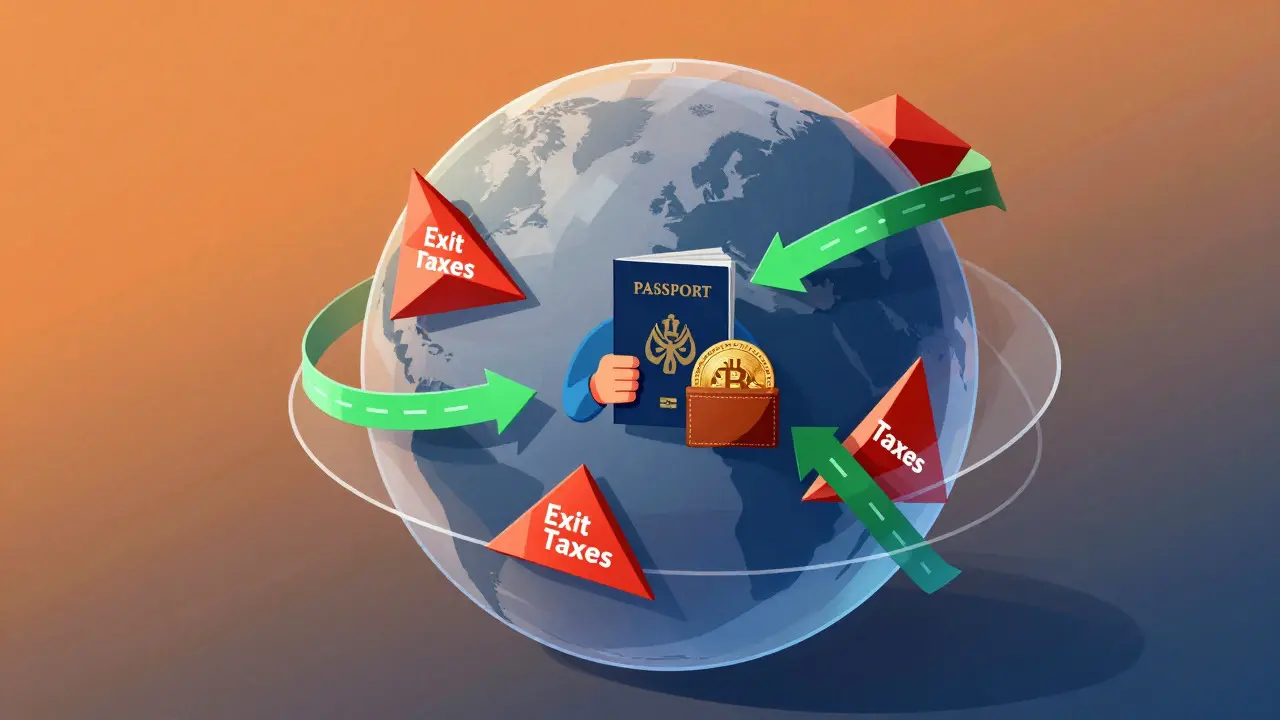
The biggest hurdle for many wealthy crypto investors is the exit tax. Countries like the United States, Canada, and Australia view expatriation as a taxable event. If you move to Malta or Puerto Rico, you might trigger a tax bill based on the fair market value of your crypto holdings at the time of departure.
Consider this scenario: You own $5 million in Bitcoin. You move to Malta. The IRS says you sold $5 million worth of assets yesterday. You owe 23.8% on any gain above the exclusion limit. That could be hundreds of thousands of dollars in cash needed immediately. To mitigate this, experts suggest strategies like gifting assets to family members in lower-tax brackets before moving, or using trusts to defer recognition. These moves must be planned well in advance, not at the last minute.
Another risk is the changing regulatory environment. In 2026, international tax cooperation is stronger than ever. The OECD's global minimum tax initiatives are pressuring small jurisdictions to raise rates. While Puerto Rico and Malta have strong legal frameworks, there is always a chance that future legislation could close loopholes. Always consult with a cross-border tax attorney before making irreversible moves.
Step-by-Step Implementation Plan
Executing a citizenship or residency strategy for tax reduction is not a DIY project. Follow these steps to ensure compliance and success:
- Audit Your Crypto Portfolio: Document every acquisition date, cost basis, and current value. You will need this for both tax filings and due diligence.
- Consult a Specialist: Hire a lawyer who specializes in both immigration and crypto tax law. Generalists often miss critical details about token classification.
- Choose Your Path: Decide if you need a passport (CBI) or just residency (RBI). Consider your travel needs and family situation.
- Prepare Source of Funds: Convert enough crypto to fiat to cover application fees and initial living expenses. Keep detailed records of the conversion.
- Apply and Wait: Submit your application. Be prepared for background checks that can take several months.
- Establish Physical Presence: Once approved, move to the jurisdiction. Spend the required days there to maintain bona fide status.
- File Correctly: Continue filing taxes in your home country until you officially sever ties. File for residency in the new country immediately.
FAQ
Can I use cryptocurrency directly to buy citizenship?
Most governments do not accept direct crypto payments for citizenship applications. You typically need to convert your crypto to fiat currency (USD, EUR, etc.) first. The funds must then be transferred via traditional banking channels to show a clear audit trail. Some newer programs are starting to accept stablecoins, but this is rare.
Is Puerto Rico Act 60 still valid in 2026?
Yes, Act 60 remains active and is widely used by tech and crypto professionals. However, eligibility requirements regarding physical presence and economic interest are strictly enforced. You must genuinely relocate your life to Puerto Rico to maintain the tax benefits.
Do I lose my US citizenship if I move to Malta?
No. Moving to Malta does not force you to renounce your US citizenship. You can hold dual citizenship. However, the US taxes based on citizenship, not residency. So unless you formally renounce your US passport (which triggers an exit tax), you will still file US tax returns, even if you pay no tax in Malta.
How much does it cost to get residency in Malta?
The Malta Permanent Residence Programme (MPRP) requires a combination of government contributions, property rental or purchase, and proof of financial assets. Total costs usually start around €150,000 to €250,000 depending on whether you rent or buy property and your family size.
What happens if I sell crypto after moving to a tax haven?
If you have successfully established tax residency in a territory like Puerto Rico under Act 60, capital gains realized after your move are generally tax-free. However, if you are still a tax resident of your home country (e.g., the US), you will owe taxes on those gains regardless of where you live. Breaking tax residency is the critical step.
Are Caribbean CBI programs safe for crypto investors?
They are legally safe but carry reputational and compliance risks. Due diligence is rigorous. If your crypto history is opaque, you may be rejected. Additionally, these passports do not shield you from home-country taxes if you remain a tax resident there. They are best used for travel freedom rather than immediate tax evasion.