
When you hear that blockchain data is "immutable," it sounds like a promise written in stone. No edits. No deletions. No going back. But is that really true? Can blockchain data ever be changed or deleted? The short answer: blockchain data is designed to be unchangeable - but under the right conditions, it can be. Not easily. Not legally. Not without consequences. But it can happen.
How Blockchain Keeps Data Locked In
Every block in a blockchain holds a unique digital fingerprint - a cryptographic hash - of the data inside it. That hash also includes the hash of the previous block. So if you change even one letter in a transaction from six months ago, the hash of that block changes. And because every next block references the previous one’s hash, every single block after it becomes invalid. To fix it, you’d need to recalculate every single hash from that point forward. That’s not just hard - it’s nearly impossible on big networks like Bitcoin or Ethereum. Why? Because the network isn’t stored in one place. It’s copied across tens of thousands of computers around the world. To alter the chain, you’d need to control more than half of all the computing power on the network at the same time. That’s called a 51% attack. And on Bitcoin, with over 400 exahashes per second of processing power, it would cost over $12.7 billion in hardware and $50 million a day in electricity just to try. Add to that the consensus rules - Proof-of-Work or Proof-of-Stake - that require network-wide agreement before any new block is added. No single person, company, or government can just flip a switch and delete a transaction. The system was built to make that impossible.When Immutability Breaks: Real Cases
But here’s the twist: it has broken before. In 2016, hackers stole $60 million worth of Ether from a project called the DAO. The Ethereum community faced a choice: let the theft stand, or reverse it. They chose to reverse it. In a move that shocked many, Ethereum’s developers rolled back the blockchain to before the hack. This created two blockchains: one where the hack never happened (Ethereum, or ETH), and one that stayed true to the original history (Ethereum Classic, or ETC). That hard fork didn’t just change data - it rewrote history. And it proved that immutability isn’t a law of physics. It’s a social contract. If enough people agree to change it, they can. Another example: Bitcoin Gold in May 2018. Attackers took control of 51% of the network’s mining power and reversed transactions, double-spending $18 million. Smaller blockchains are far more vulnerable. Cornell University’s 2023 research found that blockchains with fewer than 1,000 active nodes have a 34% chance of being successfully attacked within a year. Bitcoin? Near zero.Private Blockchains Don’t Play by the Same Rules
Public blockchains like Bitcoin and Ethereum are open to anyone. But most businesses don’t use them. They use private or permissioned blockchains - systems where only approved parties can participate. IBM, Microsoft, and others offer these for enterprise use. And here’s the catch: 62% of private blockchain implementations allow administrators to override consensus rules under emergency conditions. That means someone with the right access can delete or edit data. It’s not a flaw - it’s by design. Companies need to comply with laws like GDPR, which gives people the right to have their data erased. You can’t delete something from a public blockchain. But you can on a private one. That’s why most enterprise blockchain projects today don’t store sensitive data directly on-chain. They store a cryptographic hash on the blockchain - proof that the data existed - and keep the real data in encrypted off-chain databases. If someone requests deletion, they just delete the off-chain file. The hash stays on the blockchain as a record that the data was once there. But the content? Gone.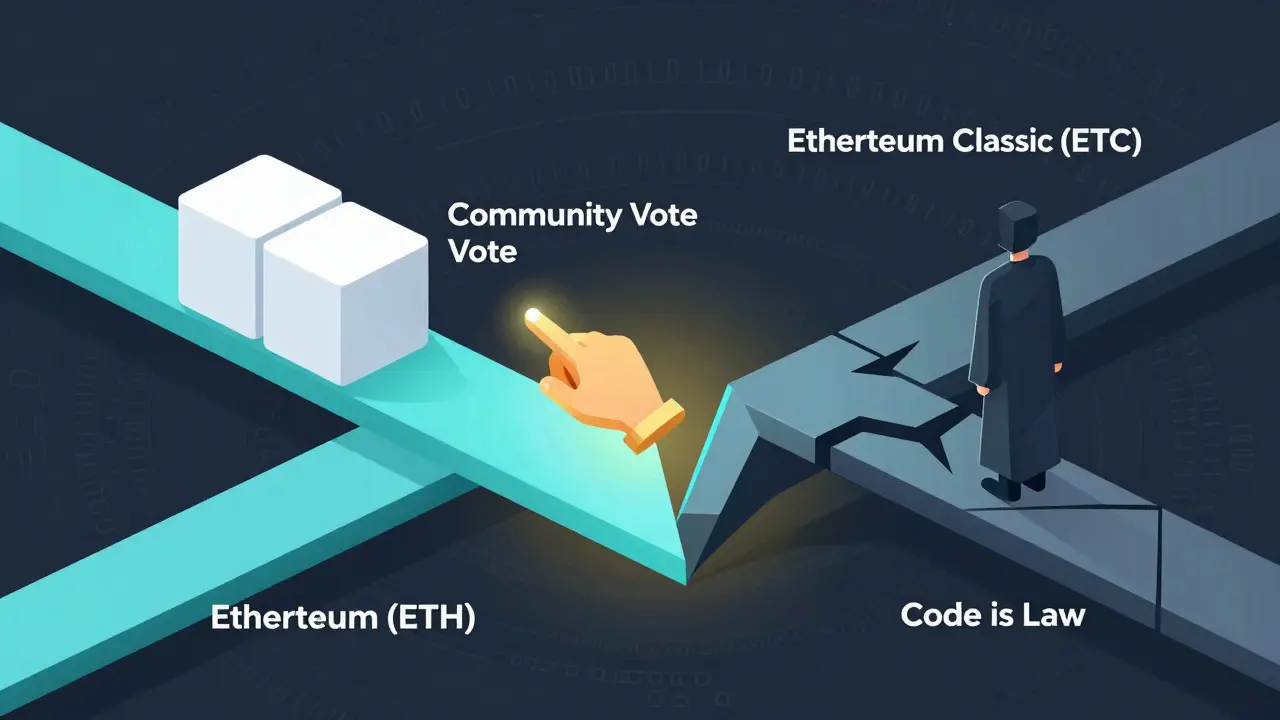
Legal and Regulatory Pressure Is Changing the Game
The European Union’s GDPR isn’t just a privacy law - it’s a blockchain disruptor. It says individuals have the right to have their personal data erased. But blockchain doesn’t erase. It remembers forever. Companies using blockchain in healthcare, finance, or e-commerce are stuck. One Reddit user from March 2025 wrote: "We had to build an off-chain encryption layer to comply with EU regulations while maintaining our blockchain solution." Deloitte’s 2025 survey found that 41% of blockchain implementations needed extra legal frameworks just to handle this conflict. The solution? Hybrid models. The W3C’s Verifiable Credentials Data Model 2.0 (released October 2024) lets you prove you own data without storing the data itself on-chain. Microsoft’s Azure Blockchain Service added a "compliance layer" in February 2025 that lets businesses delete data off-chain while keeping cryptographic proof on-chain. Ethereum’s Dencun upgrade in March 2024 made storing large amounts of data cheaper - but still didn’t make it editable.What Experts Really Think
Dr. Gavin Andresen, former lead developer of Bitcoin Core, put it simply: "Immutability is a spectrum, not a binary property." He means: it’s not about whether something can be changed - it’s about how much it would cost to do so. Vitalik Buterin, Ethereum’s co-founder, agrees: "No system is perfectly immutable; it’s about making changes prohibitively expensive." On Bitcoin, it’s prohibitively expensive. On a small private chain? Not so much. Meanwhile, the Ethereum Classic community still insists: "On POW blockchains, the principle of immutability guarantees that addresses, cryptocurrency balances, and dapps will not be changed by third parties." For them, the 2016 fork was a betrayal. They believe true blockchain means no exceptions.
Practical Challenges for Users
If you’re trying to use blockchain for data integrity, here’s what you’ll run into:- Storage costs jump 40% compared to traditional databases because every record is permanently stored.
- Developers need 120+ hours of training to understand how hashing, consensus, and key management actually work.
- Even on a private testnet with just five nodes, one developer spent 47 hours trying to alter a block - and failed.
- Documentation is all over the place. Ethereum’s guides score 4.7/5. Hyperledger Fabric’s? 3.2/5. You’ll need to dig deep to get it right.
The Future: Immutability with Escape Hatches
The industry isn’t moving toward perfect immutability. It’s moving toward smart immutability. By 2027, Forrester predicts 73% of enterprise blockchain systems will use hybrid models - combining on-chain proof with off-chain data storage. That way, you get the trust of a tamper-proof ledger, without the legal nightmares of unerasable personal data. Quantum computing could also change the game. Today’s cryptographic hashes could be broken by powerful quantum machines in the next few years. MIT’s 2025 whitepaper says blockchain networks will need to adopt quantum-resistant algorithms by 2028 - which could mean re-writing parts of the chain to stay secure.So, Can Blockchain Data Be Changed or Deleted?
Yes - but only under specific, extreme, or engineered conditions:- On public blockchains: Only through a 51% attack (rare and expensive) or a community hard fork (social, not technical).
- On private blockchains: Easily - by design, for compliance.
- On hybrid systems: Data is deleted off-chain; only a cryptographic proof remains on-chain.
Can I delete a transaction from Bitcoin?
No, you cannot delete a transaction from Bitcoin’s blockchain. Once confirmed, it’s permanently recorded across thousands of nodes. The only way to "remove" it would be to reverse the entire chain through a 51% attack - which is nearly impossible due to Bitcoin’s massive computing power. Even if you could, the network would reject the altered version, and you’d end up with two conflicting chains, not one clean deletion.
What happened in the Ethereum DAO hack?
In 2016, hackers stole $60 million from the DAO, a decentralized investment fund on Ethereum. Instead of letting the theft stand, Ethereum’s developers proposed a hard fork - a major software upgrade that rolled back the blockchain to before the hack. This created two versions of Ethereum: Ethereum (ETH), which erased the hack, and Ethereum Classic (ETC), which kept the original history. The fork proved that blockchain immutability depends on community consensus, not just code.
Can GDPR be followed with blockchain?
Yes, but not directly. GDPR requires personal data to be deletable. Since blockchain can’t delete data, companies use hybrid systems: they store only a cryptographic hash of the data on-chain, and keep the real data in encrypted off-chain databases. When someone requests deletion, they erase the off-chain data. The hash stays on-chain as proof the data existed - but the content is gone. This approach satisfies both blockchain integrity and privacy laws.
Are private blockchains truly immutable?
No. Private or permissioned blockchains are often designed with administrative overrides. About 62% of enterprise blockchain systems allow authorized users to edit or delete data under emergency protocols. These systems prioritize control and compliance over absolute immutability - making them more like secure databases with blockchain-style verification, not true public blockchains.
Is a 51% attack the only way to change blockchain data?
No. A 51% attack is the most direct technical way to alter a public blockchain’s history - but it’s not the only way. Community-driven hard forks, like Ethereum’s 2016 rollback, can change history without hacking. Also, private blockchains allow admins to edit data directly. And hybrid systems avoid the issue entirely by keeping sensitive data off-chain. So while 51% attacks are dangerous, they’re just one of several paths to changing blockchain data.
Why does blockchain cost more to store than a regular database?
Blockchain stores every single piece of data permanently, across thousands of nodes. There’s no deletion, no compression, no overwriting. Every transaction is replicated everywhere. This append-only design increases storage needs by 40% on average compared to traditional databases, which can delete, update, or archive data. That’s why many companies only store hashes on-chain and keep the real data elsewhere.
Will quantum computers break blockchain immutability?
Not directly - but they could break the cryptography that keeps blockchain secure. Today’s blockchains use SHA-256 and ECDSA hashing, which quantum computers could crack in the future. If that happens, attackers could forge signatures or alter transaction histories. That’s why MIT and others are already developing quantum-resistant algorithms. The blockchain itself won’t change - but its underlying security will need to be upgraded, possibly requiring new versions of the chain.
Can a blockchain be reset or restarted?
You can’t reset a public blockchain like Bitcoin or Ethereum - it’s too decentralized. But you can create a new one. That’s what happened with Ethereum and Ethereum Classic. You can also restart a private blockchain from scratch if you control all the nodes. In that case, it’s not a reset - it’s a new system. The old chain remains untouched, but no one uses it anymore.
Does immutability make blockchain better for records?
Yes - if you need proof that something happened and can’t be altered. That’s why supply chains, land registries, and audit logs use blockchain. But if you need to correct errors, update records, or delete personal data, blockchain isn’t ideal by itself. It’s best used as a tamper-proof log, not a live database. Combine it with off-chain systems for flexibility.
What’s the difference between Ethereum and Ethereum Classic?
They’re two separate blockchains that split after the 2016 DAO hack. Ethereum (ETH) reversed the hack and continues as the main chain today. Ethereum Classic (ETC) kept the original chain, including the hack, to uphold the principle that "code is law" and no history should be rewritten. ETH is now the larger, more widely used chain. ETC remains a symbol of absolute immutability for purists.
Steve Fennell
January 25, 2026 AT 22:43Immutability is cool until you need to delete your ex’s crypto address from your wallet. 😅
Chidimma Catherine
January 26, 2026 AT 18:37Blockchain is not magic it is code written by humans who make mistakes and sometimes those mistakes need correction. In Nigeria we say 'the pot does not cook for the thief alone' meaning systems must allow for justice not just rigidity. The Ethereum fork was right. Data should serve people not the other way around.
Taylor Mills
January 27, 2026 AT 05:40USA built the internet and now europe wants to delete it with gdpr. blockchain is supposed to be untouchable. if you cant handle that then dont use it. stop crying about your data. its not your data its a public ledger. get over it.
Arielle Hernandez
January 27, 2026 AT 07:53It's critical to distinguish between technical immutability and social consensus. The 2016 Ethereum fork didn't break the blockchain-it revealed that blockchain's authority is derived from community trust, not cryptographic inevitability. Private chains with admin overrides are not blockchains in the Satoshi sense-they're distributed databases with a fancy hash layer. And hybrid models? That's the only pragmatic path forward for enterprise adoption. The future isn't pure immutability. It's intelligent, context-aware immutability.
Mathew Finch
January 29, 2026 AT 00:56Anyone who thinks private blockchains are real blockchain hasn't read the whitepaper. You're just running a SQL database with a blockchain-shaped wrapper. And don't get me started on 'hybrid models'-that's just capitalism trying to have its cake and eat it too. If you need to delete data, use a database. Don't pretend you're building the next Bitcoin with your permissioned chain.
Jessica Boling
January 30, 2026 AT 20:36So we're saying blockchain is immutable unless someone with a PhD and a corporate budget says otherwise? Cool cool. I'll just store my will in a Google Doc then. Much easier to edit when Aunt Linda dies again. 😏
Tammy Goodwin
January 31, 2026 AT 09:07I think the real issue isn't whether data can be changed-it's whether we should be storing personal data on any kind of public ledger in the first place. Maybe the solution isn't hacking immutability, but just not putting sensitive stuff there. Simple, right?
MOHAN KUMAR
January 31, 2026 AT 22:1451% attack is expensive but possible. Private chains are fake. GDPR is law. So what to do? Use hash on chain, real data off chain. Done. No drama. No cry. Just work.
Jennifer Duke
February 2, 2026 AT 18:53Actually, the real genius isn't in the blockchain-it's in the off-chain architecture. Most people don't realize that the most sophisticated blockchain deployments today are essentially zero-knowledge proof systems with a tamper-evident ledger. The blockchain isn't the database; it's the notary. And if you're still storing raw PII on-chain? Honey, you're not a pioneer-you're a liability waiting for a class action lawsuit.
Andy Marsland
February 3, 2026 AT 10:14Let's be clear: the entire premise of blockchain immutability is being weaponized by corporations who want the appearance of decentralization without the actual accountability. They use private chains with admin backdoors, call it 'enterprise-grade,' and then sell it as 'trustless technology.' Meanwhile, the average user is left confused, thinking they're using something revolutionary when in reality they're just using a glorified SQL server with a blockchain sticker on it. And don't even get me started on the crypto bros who still think Ethereum Classic is 'pure'-it's a dead chain with a cult following and zero liquidity. Immutability is not a virtue-it's a design choice, and when that choice conflicts with human rights like privacy, the choice must change. The blockchain isn't sacred. The people are.
Tselane Sebatane
February 4, 2026 AT 16:14Look, I've worked on blockchain systems in Johannesburg and Cape Town, and let me tell you-no one cares about immutability when your client's medical records are stuck on-chain and they need to be deleted for insurance purposes. We built a system where the blockchain holds a hash and a timestamp, and the real data lives in encrypted AWS buckets with automatic deletion triggers tied to GDPR requests. It works. People don't need to know how it works-they just need to know their data disappears when they ask. That's the real innovation: not the blockchain, but the quiet, unsexy layer underneath it that actually protects human rights. The blockchain? It's just the receipt. And receipts can be archived without keeping the whole shopping cart.