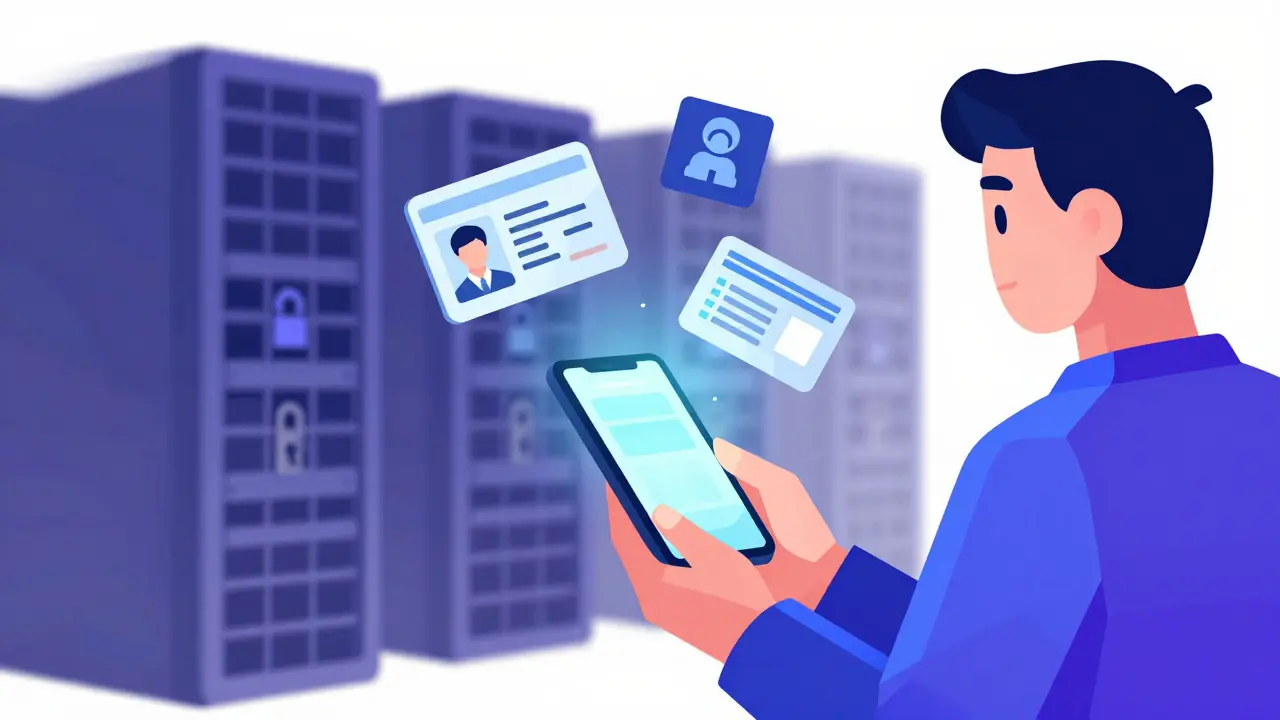
Imagine logging into your bank, signing a contract, or accessing your medical records - without handing over your passport, social security number, or any personal details. Just a quick scan, a tap on your phone, and you’re in. No forms. No waiting. No company storing your data in a server somewhere you can’t see. This isn’t science fiction. It’s happening now - thanks to blockchain digital identity solutions.
For years, companies and governments have held your identity like a locked file cabinet. Your name, address, birth date, even your face - all stored in their databases. If those databases get hacked? Your identity gets stolen. If they get sold? Your data becomes a commodity. Blockchain changes that. It flips the script. Instead of giving your identity away, you keep it. And you decide who gets to see what.
What Is Blockchain Digital Identity?
At its core, blockchain digital identity is about self-sovereign identity (SSI) - meaning you, the person, are the owner and controller of your identity. No middleman. No central authority. You don’t need Facebook, Google, or your government to verify who you are. Instead, you store verified pieces of your identity - like your driver’s license, university degree, or citizenship status - in a digital wallet on your phone. These pieces are called Verifiable Credentials, and they’re signed with cryptography so no one can fake them.
The backbone of this system is Decentralized Identifiers (DIDs). Unlike traditional usernames or email addresses tied to a company’s server, DIDs are unique, blockchain-based codes you generate yourself. Think of them like a digital fingerprint that only you control. When you need to prove you’re over 18, you don’t send your birth certificate. You send a cryptographically signed proof that says, "Yes, this person is over 18," without revealing your actual birth date.
This isn’t theory. Estonia’s e-Residency program uses this exact model. Before blockchain, applying for e-Residency took two weeks. Now? It’s done in 48 hours. Why? Because the system verifies your identity using digital credentials linked to your blockchain ID - not paper documents or manual checks.
How It Works: No More Passwords, Just Proofs
Here’s how it actually works in practice:
- You get a digital wallet - like a crypto wallet, but for your identity. Apps like Sovrin, IOTA Identity, or Microsoft ION let you store your credentials.
- You receive a Verifiable Credential from a trusted issuer - say, your university. They sign it with their private key and send it to your wallet. It’s tamper-proof.
- When you apply for a job, you open your wallet and select: "I have a degree in Computer Science." You don’t send the diploma. You send a cryptographic proof that it’s real.
- The employer’s system checks the proof against the blockchain. It doesn’t see your name, your GPA, or your student ID. It just sees: "Valid credential. Issued by XYZ University. Signed. Authentic."
That’s it. No database lookup. No server breach risk. No copying your passport. Your data stays with you.
Why This Is a Game-Changer for Industries
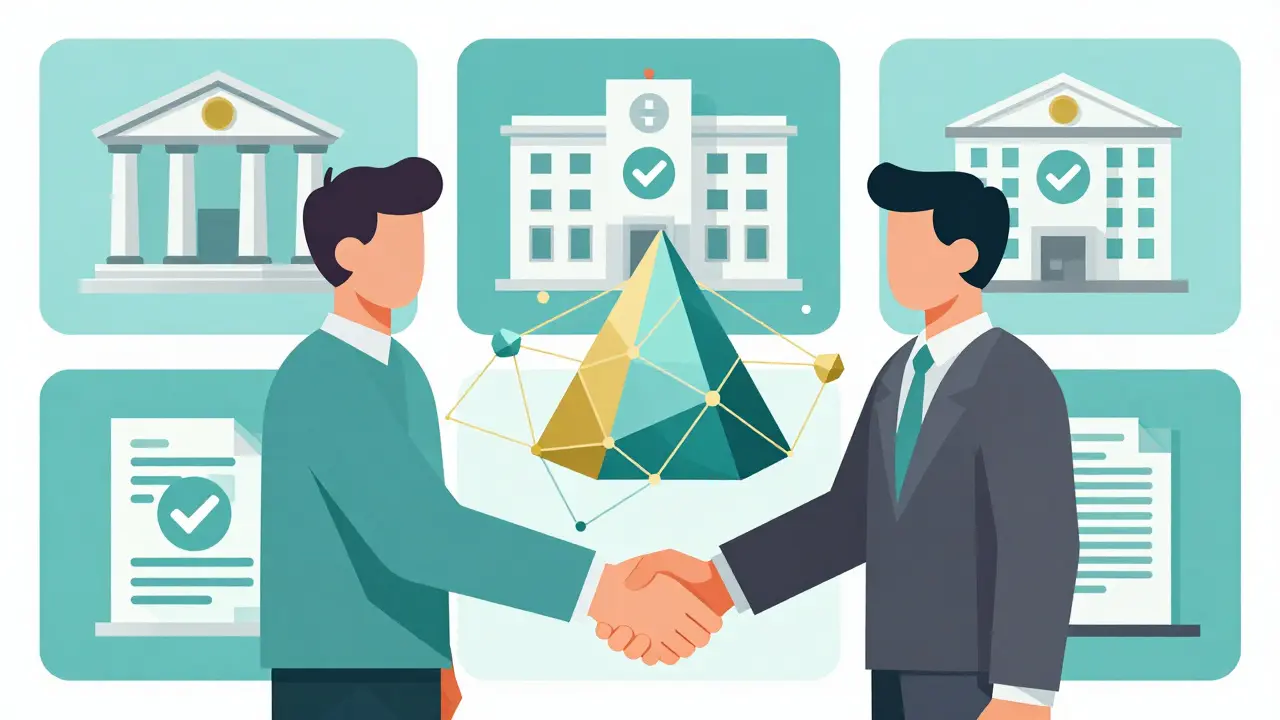
Finance is the first to adopt this. JPMorgan cut KYC (Know Your Customer) processing from five days to under two hours using blockchain identity. That’s not just faster - it’s cheaper. They saved 65% on verification costs. Why? Because they stopped storing customer data. They just verify claims.
Healthcare is next. During the pandemic, people struggled to prove they were vaccinated. Paper cards got lost. Digital records were siloed. Now, hospitals and clinics use blockchain credentials. A patient shows their vaccine status with one tap. No app login. No portal. Just a secure proof. According to Fortune Business Insights, healthcare will grow at 87.8% CAGR in blockchain identity adoption by 2032 - the fastest of any sector.
Government services are catching up too. The UN’s Pension Fund (UNJSPF) used blockchain identity to cut pension fraud by 37% and speed up payments by 82%. Fraudsters can’t fake a credential signed by a government agency and stored on a public ledger.
Even landlords and renters are using it. In the UK, pilot programs let tenants prove income, rental history, and creditworthiness without sharing bank statements. Landlords get instant verification. Tenants keep their privacy.
Real Numbers. Real Impact.
Let’s get concrete:
- Verification speed: Blockchain systems confirm identity in 1.2-2.8 seconds. Traditional KYC? 2-5 business days.
- Cost reduction: Financial firms cut identity verification costs by 60-70%.
- Market growth: The global blockchain identity market will jump from $1.57 billion in 2025 to $118.96 billion by 2032.
- Adoption: 48% of financial institutions have implemented blockchain identity. Only 18% of consumers use it - because it’s still hard to set up.
And here’s the kicker: 73% of companies using blockchain identity report lower fraud. That’s not a guess. That’s from enterprise surveys.
The Downsides: Why It’s Not Everywhere Yet
It’s not magic. There are real problems.
First, user experience. If you’ve ever lost a crypto wallet key, you know how scary it is. With identity, losing your key means losing access to your entire digital life - your job, your bank, your medical records. 57% of consumer reviews complain about wallet recovery. If you forget your password? Reset it. If you lose your DID key? You might be locked out forever.
Second, integration. Most companies still run on 20-year-old systems. Connecting those to blockchain isn’t plug-and-play. 72% of enterprises say legacy system integration is their biggest hurdle.
Third, regulation. The EU has eIDAS 2.0. The US has DHS funding projects. But in many countries, there’s no legal framework for blockchain IDs. Can a digital credential replace a passport? Not yet everywhere.
And then there’s the learning curve. 63% of enterprise users need training just to use the system. It’s not intuitive. You need to understand keys, signatures, and revocation - things most people don’t care about.
What’s Next? Four Trends Shaping the Future
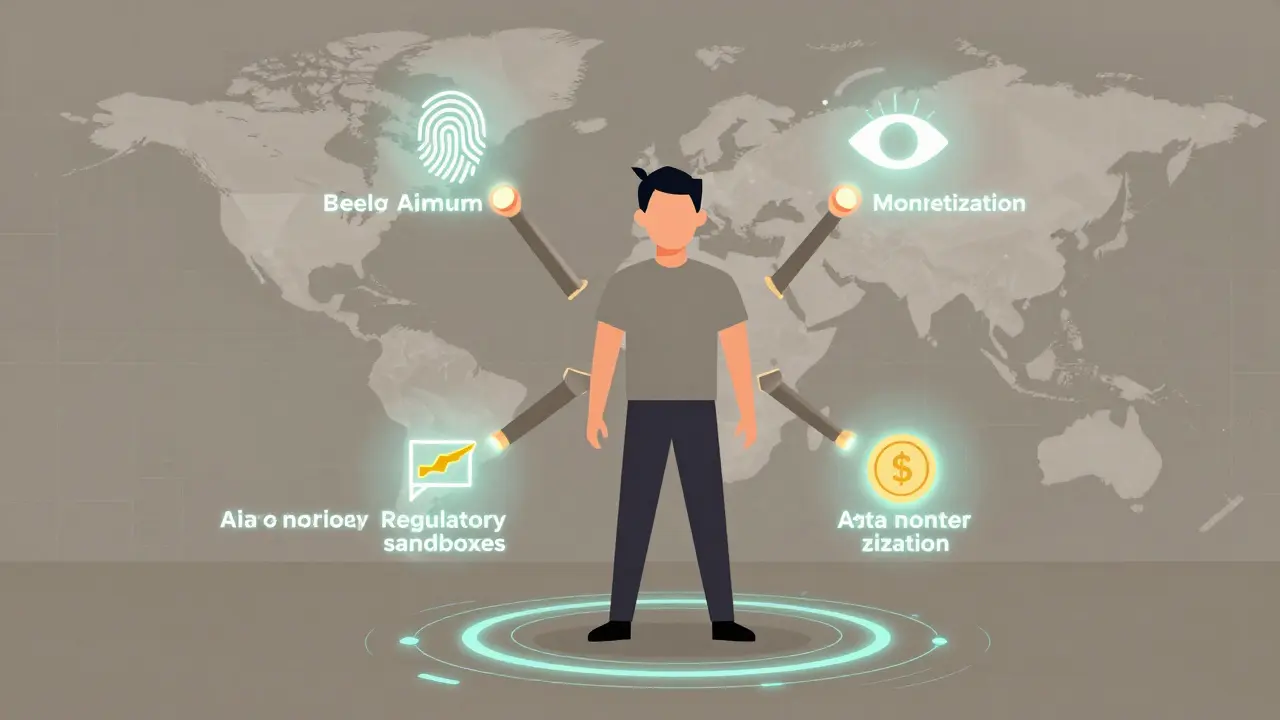
By 2028, Gartner predicts blockchain identity will be mandatory for 75% of enterprise digital interactions. Here’s how it’s evolving:
- Biometrics + blockchain: Your face or fingerprint now unlocks your DID. No passwords. Just you.
- AI fraud detection: AI spots fake credentials in real time. Pilot programs cut false positives by 63%.
- Regulatory sandboxes: 17 countries now run test zones where cross-border digital IDs work legally.
- Data monetization: Imagine letting companies pay you for access to your verified employment history - with your permission. You earn. They get clean data. Win-win.
These aren’t distant ideas. They’re live in 2026.
Should You Care? Yes - Even If You’re Not a Tech Expert
You don’t need to code a blockchain to benefit from it. What matters is control. Right now, every time you sign up for a new app, you’re giving away part of yourself. Your location. Your spending. Your contacts. Your face.
With blockchain identity, you choose. You can share just enough. Nothing more. You can revoke access anytime. You own the record.
It’s not about replacing your ID card. It’s about replacing the old system - where corporations hold your identity hostage - with one where you’re in charge.
And that? That’s the real revolution.
Can blockchain digital identity replace my passport or driver’s license?
Not yet everywhere, but it’s getting close. Countries like Estonia and parts of the EU already accept blockchain-based digital IDs for official use. In the US and UK, pilots are underway for border control and age verification. The key is legal recognition. As more governments adopt W3C Verifiable Credentials standards, blockchain IDs will become legally equivalent to physical documents - but with far better security and privacy.
What happens if I lose my phone or forget my wallet password?
This is the biggest risk. Unlike a password reset, blockchain identity keys can’t be recovered by a company. If you lose your private key and haven’t backed it up properly, you lose access to all your credentials. That’s why most wallets now offer recovery phrases (12-24 words) and multi-signature options. Some also allow trusted contacts or social recovery - where friends or family help you regain access. But you must set this up before you need it.
Is blockchain identity more secure than passwords or two-factor authentication?
Yes - by design. Passwords get stolen. SMS codes get intercepted. Biometrics can be spoofed. Blockchain identity uses cryptographic proofs that can’t be copied or forged. The credential itself is signed by the issuer, stored on your device, and verified against a public ledger. No central server to hack. No database to leak. Even if your phone is stolen, the credential can’t be used without your biometric unlock or recovery key. It’s not perfect, but it’s the most secure model we have today.
Can companies still track me with blockchain identity?
They can track what you choose to share - but not everything. With blockchain identity, you only reveal the minimum needed. A landlord doesn’t see your salary - just that you earn above rent. A pharmacy doesn’t see your full medical history - just that you’re eligible for a prescription. The blockchain doesn’t store your personal data. It only stores proof that the data is valid. So yes, companies can see what you allow them to see - but they can’t dig deeper. That’s the whole point.
Is blockchain identity only for tech-savvy people?
No - but it’s easier if you’re comfortable with apps. Modern wallets look like regular mobile apps: you tap, scan, approve. You don’t need to understand cryptography. The complexity is hidden. The problem isn’t the tech - it’s the lack of standardization. Some wallets are easy. Others are clunky. As the market matures (2026-2027), usability will improve dramatically. For now, it’s still early, but not impossible for non-tech users.
Blockchain digital identity isn’t about replacing your ID card. It’s about replacing a broken system - one where your data is a liability, not a right. The future isn’t about more passwords. It’s about control. And that future is already here.
Angela Henderson
February 16, 2026 AT 21:07So like, imagine you’re just trying to get a loan, right? And instead of sending your whole life story to some bank’s server that probably got hacked last Tuesday, you just tap your phone and say, ‘Yeah, I make money, I’m not a ghost.’ No forms. No waiting. No ‘please verify your identity with three different government IDs.’ It’s weirdly peaceful, honestly. Like, I didn’t even know I was tired of being treated like a data point until this existed. Now I just feel… lighter. Like I’m not constantly handing over pieces of myself just to open a bank account. And yeah, I know it’s not perfect. But it’s the first time I’ve felt like my identity actually belongs to me. Not Amazon. Not Chase. Not some guy in a cubicle in Bangalore who’s paid to verify my face. Me.
Also, I lost my wallet once. Like, physically. My purse. And I had to redo everything. This? I’d rather lose my phone. At least I can get a new one. Can’t get a new me.
Anyway. Just… yeah. This is good. I’m not techy. But I like this.
Also, can we please stop calling it ‘blockchain’ like it’s a religion? It’s just a tool. A really smart one.
Paul David Rillorta
February 16, 2026 AT 23:14OMG so this is just the government’s way of putting a chip in your brain but now it’s ‘decentralized’ so it’s ‘ethical’ lmao
you think they don’t track every DID? like bro the blockchain is public. every time you prove you’re over 18 or that you ‘have a degree’ it’s logged. forever. and who do you think controls the issuers? the same ppl who run the old system. just now they’re the ‘trusted validators’ and you’re the sucker who thinks you’re in charge.
they’ll just make you sign 1000 credentials just to buy milk. ‘prove you’re not a terrorist, prove you didn’t vote for trump, prove you’re not a communist, prove you didn’t tweet something in 2018.’
it’s not freedom. it’s surveillance with better branding.
also, if you lose your key? congrats. you’re now a ghost. no one can help you. not even the government. which is why this is perfect for them. you’re disposable.
also, why is everyone acting like this isn’t just crypto with a new name? we all know how that ended. remember the ponzi schemes? this is the same thing. just with more lawyers and less memes.
Lauren Brookes
February 17, 2026 AT 08:32There’s something deeply human about this idea. Not the tech. The control. The fact that you get to decide what part of you to show, and when.
I used to work in healthcare admin. We’d get people coming in with 30 pages of paperwork just to get a flu shot. Half of it was redundant. The other half was outdated. The system didn’t care if you’d already proven you were vaccinated last year. It just wanted another form. Another signature. Another copy.
Now imagine if you could just say, ‘I’m vaccinated.’ And the system knew it was true. Without seeing your name. Without knowing your address. Without storing it. Just… verified.
That’s not just efficiency. That’s dignity.
But I also worry about the people who can’t afford smartphones. Or who don’t trust tech. Or who’ve been burned before. This can’t be a luxury. It has to be a right. Otherwise, we’re just building a new kind of class system - one where your identity is locked behind a phone, a backup phrase, and a 12-word sentence you wrote in 2023 and forgot by 2025.
So yes. This is beautiful.
But it’s also fragile.
We have to build it with everyone in mind. Not just the ones who already get it.
Andrew Edmark
February 18, 2026 AT 16:07Hey, I just wanted to say I’m really glad someone wrote this. I’ve been trying to explain this to my dad and he keeps thinking it’s like Bitcoin and he’s like ‘so I lose my money if I lose my phone?’ and I’m like ‘no dad, you lose your ID, not your money’ and he’s like ‘so it’s worse?’
Anyway. I got my first verifiable credential last week - my university degree. It was so simple. Opened the app. Tapped ‘show credential.’ The employer scanned it. Done. No email. No portal. No ‘please upload a PDF.’
And the best part? I didn’t have to give them my GPA. Or my student ID. Or my thesis title. Just ‘degree earned.’ That’s it.
I cried. Not because it was emotional. But because it was… normal. Like, why did it take this long for this to happen?
Also, if you’re scared of losing your key? Set up social recovery. Talk to a friend. Give them one of your backup phrases. It’s not hard. I did it. My sister has mine. She’s the only one who knows. And if I ever go missing? She can help me get back in.
You’re not alone in this. You just have to plan for it. Like locking your doors. Like having insurance.
It’s not magic. But it’s better than what we had.
🙂
Dominica Anderson
February 19, 2026 AT 00:38This is why America is falling behind. Europe’s got eIDAS. Estonia’s got digital citizens. And here we are, still asking for social security numbers like it’s 1998.
It’s not rocket science. It’s basic governance. If you can’t modernize identity, you can’t compete. Period.
And no, ‘user experience’ isn’t an excuse. If you can’t figure out how to use a wallet, you shouldn’t be online.
Stop romanticizing incompetence.
Also, 73% lower fraud? That’s not a ‘kicker.’ That’s a wake-up call.
Grow up.
Aileen Rothstein
February 20, 2026 AT 23:31I love how this flips the script. We’ve been taught that data is valuable - but only if corporations own it. What if *we* owned it? What if we could *rent* our verified employment history to companies for a few bucks? Imagine getting paid every time a recruiter checks your credentials. Not because they’re spying on you. Because you’re letting them see something you chose to share.
And yes, I know - ‘data monetization’ sounds like a Silicon Valley buzzword. But think about it. You’ve been monetized your whole life. Your attention. Your clicks. Your location. Your purchases. Now imagine if you got a cut of it. Not from ads. From *truth*.
This isn’t just about security. It’s about justice.
Also, I’m 29. I’ve had my identity stolen three times. This? This is the first thing that actually makes me feel safe.
And if you’re worried about losing your key? Then set up a backup. Use your spouse. Use your kid. Use your dog. Just don’t ignore it. This isn’t ‘tech stuff.’ It’s life stuff.
Let’s build this right. Not just faster. Better.
Jennifer Riddalls
February 22, 2026 AT 05:14Just wanted to say I’m really glad I read this. I’m not a techie. I’m a single mom who works two jobs. I didn’t even know what a blockchain was two months ago. But when my kid needed to enroll in school and I had to prove I was his guardian? I used the app. Took 30 seconds. No notarization. No trip to the courthouse. Just a tap.
I didn’t even know I was holding my breath until it was done.
Also, I lost my phone last week. Got a new one. Restored from backup. My credentials came back. No panic. No paperwork. Just… there.
It’s not perfect. But it’s better than crying in front of a government office.
Thank you for making this real.
Love you all.
- Jen
Jeremy Fisher
February 23, 2026 AT 03:45Let’s be real - this isn’t just about identity. It’s about trust. We used to trust institutions. Then we stopped trusting institutions. Now we’re trying to trust code. And honestly? That’s a bigger leap than any tech shift.
I grew up in Ireland. We didn’t have digital IDs. We had neighbors. We had letters. We had handwritten signatures and stamped envelopes. People didn’t hack each other because they knew each other’s names.
Now? We’re trading personal trust for cryptographic trust. And I get it. It’s faster. It’s scalable. But it’s also colder.
What happens when the system fails? When the blockchain goes down? When the issuer’s signature is revoked? When your DID gets flagged because someone else used your phone? Who do you call? A bot? A helpdesk in Manila?
I’m not against this. I’m just… curious. Are we building a better system? Or just a faster one?
And more importantly - are we still human in it?
Just wondering.
Anandaraj Br
February 24, 2026 AT 09:57bro this is sooo basic
why are you all acting like this is new
we had this in india since 2018
aadhaar is literally this but better
you scan your face you get your id no one stores your data
and we dont need 12 word phrases
you just use your phone
and you dont lose access because the govt has backup
so stop acting like americans invented logic
we had digital identity before you knew what a wallet was
and we dont cry when we lose our phone
we just reverify
peace
AJITH AERO
February 24, 2026 AT 21:08so you’re telling me i can now prove i’m over 18 without showing my face to a 17 year old at a gas station
oh wow
game changer
next up: blockchain toilet paper
impressive
andy donnachie
February 25, 2026 AT 16:01Just wanted to add - in Ireland, we’re piloting this for cross-border healthcare. Someone from Portugal gets treatment here, and their vaccine record is verified via DID. No paperwork. No delays. No language barriers. Just a quick scan. It’s been life-changing for elderly patients.
And yes, it’s not perfect. Some folks still don’t trust it. But once they try it? They never go back.
It’s not about the tech. It’s about removing friction. And that’s something we all understand.
Keep building. Keep listening.
- Andy