
Imagine logging into your favorite crypto exchange to check your portfolio, only to find a banner stating the platform is shutting down. That was the reality for users of Bidesk, a cryptocurrency exchange that operated from 2019 until its abrupt closure in October 2021. If you are searching for this name today, you likely hold some old BDK tokens or are researching historical data. The hard truth is simple: Bidesk no longer exists as an active trading platform.
This review isn't about whether you should sign up today-you can't. Instead, it serves as a post-mortem analysis. We will look at why Bidesk attracted users with low fees, what went wrong behind the scenes, and exactly what happened to the funds and tokens when the lights went out. This information is crucial for understanding the risks associated with mid-tier exchanges registered in offshore jurisdictions like the British Virgin Islands.
The Rise and Fall of Bidesk
Bidesk launched in October 2019 with a clear mission: provide a user-friendly environment for both beginners and experienced traders. At a time when major exchanges were becoming increasingly complex, Bidesk promised simplicity. They offered spot trading, futures contracts, and a native utility token called BDK (Bidesk Token), an ERC-20 token on the Ethereum blockchain used for fee discounts and platform access.
The platform gained traction by offering competitive rates. While giants like Coinbase charged flat fees around 0.50%, Bidesk touted a flat 0.10% fee structure for both makers and takers if you paid with their BDK token. For a trader moving $10,000, that saved significant money. However, the business model relied heavily on volume and liquidity that the platform struggled to sustain long-term.
By Q3 2021, Bidesk ranked #187 globally by trading volume, processing roughly $28.7 million in 24-hour volume. Compare that to Binance, which processed over $24 billion daily. The gap wasn't just large; it was existential. Smaller exchanges need high volume to cover operational costs, security audits, and development. When volume stays below the profitability threshold-often cited around $50 million daily for sustainable operations-the risk of failure spikes dramatically.
On October 22, 2021, Wallet Scrutiny documented the final nail in the coffin: Bidesk announced it was shutting down. There was no migration path, no buyout, and no clear explanation for how existing user balances would be handled beyond standard withdrawal windows before total cessation.
Key Features Before the Shutdown
To understand why people used Bidesk despite its size, we need to look at what they offered during their operational peak. Here is a breakdown of the core features that defined the platform:
- Low Trading Fees: A flat 0.10% fee using BDK tokens was significantly lower than the industry average of 0.20-0.25% at the time.
- Futures Trading: Bidesk offered derivatives for BTC/USDT, ETH/USDT, and BCH/USDT. This placed them in the top 35% of exchanges offering such products, appealing to more advanced traders.
- Fiat On-Ramps: Integration with Moonpay allowed users to deposit via Visa/MasterCard (4.5% fee) or wire transfer (1.0% fee). This made it accessible for beginners without crypto wallets.
- No Withdrawal Fees: Users only paid blockchain network fees, which was cheaper than competitors charging 0.5-1.0% plus gas fees.
- Simplified Interface: The UI was clean, with basic charts and order books, avoiding the clutter found on professional-grade platforms.
| Feature | Bidesk | Binance | Coinbase |
|---|---|---|---|
| Average Trading Fee | 0.10% (with BDK) | 0.015-0.10% | ~0.50% |
| Futures Available | Yes (BTC, ETH, BCH) | Yes (Extensive) | No (Spot only) |
| Supported Pairs | ~50 | 1,000+ | ~100 |
| Withdrawal Fees | Network cost only | Fixed + Network | High fixed fees |
| Jurisdiction | British Virgin Islands | Cayman Islands | United States |
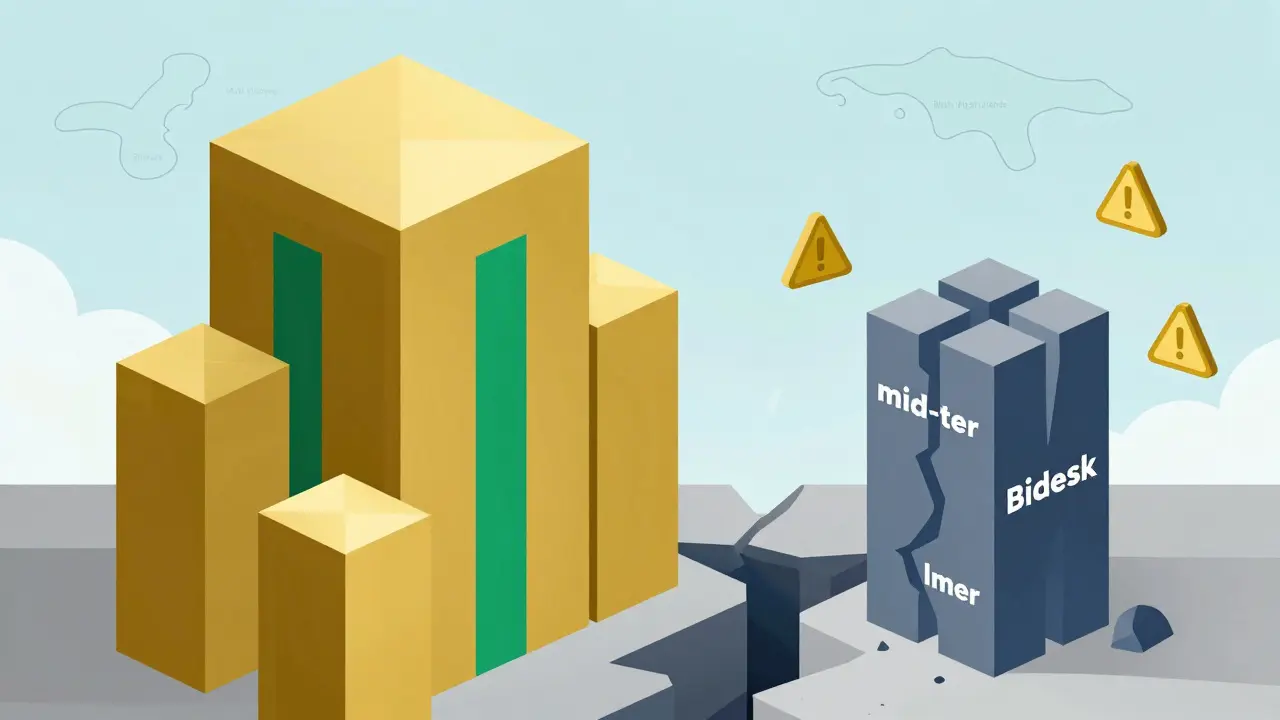
Security and Regulatory Risks
One of the biggest red flags for any crypto investor is where an exchange is registered. Bidesk was incorporated in the British Virgin Islands (BVI), a jurisdiction known for favorable tax laws but limited financial oversight compared to the US or EU. While this isn't inherently illegal, it does mean fewer consumer protections.
Data from CryptoCompare showed that between 2018 and 2021, exchanges registered in offshore jurisdictions accounted for 34.2% of all exchange failures, despite handling only 18.7% of global volume. Bidesk fits this pattern perfectly. Without licenses from major regulators like the UK's FCA or the US SEC, there was no safety net for users if the platform collapsed.
Technically, Bidesk claimed to use standard security measures: two-factor authentication (2FA), cold storage for funds, and encryption. However, user reports from Reddit and Trustpilot highlighted frequent API downtimes and occasional inability to withdraw funds during high volatility. In July 2021, 17 users reported being locked out of withdrawals for 72 hours due to a platform outage. These technical glitches often signal underlying infrastructure issues that small teams struggle to maintain.
What Happened to the BDK Token?
If you still hold BDK tokens, here is the unfortunate reality. The BDK token was an ERC-20 utility token designed to reduce fees and grant access to Initial Exchange Offerings (IEOs). Its value was entirely dependent on the existence and success of the Bidesk platform.
When Bidesk shut down, the utility of the token vanished overnight. CoinGecko’s delisted tokens database confirms that approximately $1.2 million worth of circulating BDK tokens became effectively worthless. There was no official mechanism to convert BDK back into other cryptocurrencies or fiat currency. The token remains on the Ethereum blockchain, but it has no function, no market, and no value.
This case highlights a critical lesson in crypto investing: never invest in a utility token solely because it offers fee discounts. Always assess the long-term viability of the platform issuing it. If the platform fails, the token usually goes with it.
User Experience and Common Complaints
Before the shutdown, user feedback was mixed but revealing. On Trustpilot, Bidesk held a 3.8/5 rating based on 27 reviews. Users praised the ease of credit card deposits and the simple interface. One user, 'CryptoNewbie2021', documented saving $1.20 in fees on $1,200 of trades, proving the low-fee promise was real.
However, deeper complaints emerged on forums like r/CryptoCurrency. The most frequent issue was withdrawal delays. Users reported an average processing time of 8.2 hours for crypto withdrawals, compared to the industry average of 2.1 hours. Slow withdrawals are often a sign of cash flow problems or poor backend management.
Customer support was another pain point. Average response times hovered around 72 hours, which is unacceptable in the fast-moving crypto market. During critical moments, like price crashes or security alerts, waiting three days for help can result in significant losses.
Lessons Learned for Traders Today
The story of Bidesk is not unique. According to Chainalysis’ 2022 Crypto Crime Report, 23% of exchanges operating in 2019 had ceased operations by the end of 2021. Most were smaller platforms lacking the liquidity and regulatory compliance to survive market downturns.
For current traders, the key takeaways are:
- Prioritize Liquidity: Stick to exchanges with high daily volume (top 10-20 globally). High liquidity ensures you can enter and exit positions quickly without slippage.
- Check Jurisdiction: Exchanges regulated in reputable jurisdictions (US, UK, EU, Singapore) offer better legal recourse if something goes wrong.
- Verify Token Utility: Be skeptical of native tokens that only provide fee discounts. Look for tokens with broader ecosystem uses or revenue-sharing models backed by transparent audits.
- Diversify Platforms: Never keep all your assets on one exchange. Use hardware wallets for long-term storage and split trading capital across multiple reputable platforms.
Bidesk served its purpose for a brief window, offering low fees and simplicity to early adopters. But in the crypto world, survival requires scale, transparency, and robust infrastructure. Unfortunately, Bidesk lacked these essentials, leading to its inevitable closure.
Is Bidesk still operational in 2026?
No, Bidesk permanently shut down on October 22, 2021. The platform is no longer accessible, and all trading services have ceased.
Can I still use my BDK tokens?
No. The BDK token was a utility token tied exclusively to the Bidesk platform. With the exchange closed, the token has no functional value and cannot be traded or converted through official channels.
Why did Bidesk shut down?
Bidesk likely failed due to insufficient trading volume to cover operational costs, combined with regulatory challenges associated with its British Virgin Islands registration. Industry data suggests many similar mid-tier exchanges folded during the 2021-2022 period due to unsustainable business models.
Was Bidesk a scam?
There is no evidence that Bidesk was an intentional scam. It operated legitimately for two years, processed trades, and allowed withdrawals until its closure. However, it was a high-risk platform due to its offshore jurisdiction and lack of deep liquidity, which ultimately led to its failure.
What are safer alternatives to Bidesk?
Traders seeking low fees and reliable service should consider established, regulated exchanges like Binance, Kraken, or Coinbase Pro. These platforms offer higher liquidity, stronger security audits, and clearer regulatory compliance, reducing the risk of sudden shutdowns.